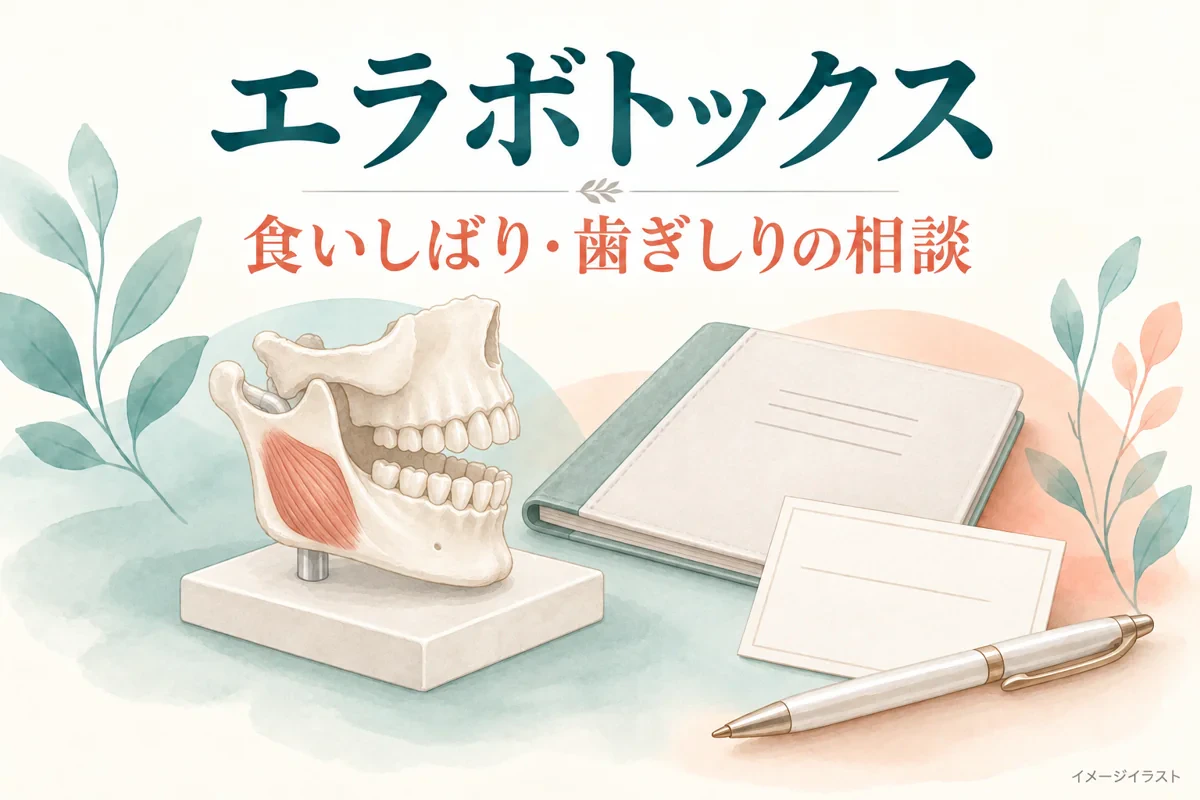
The main purpose of masseter Botox at a dental clinic is to keep too much biting force from building up, so that it protects your teeth and jaw. Does your jaw feel tired when you wake up in the morning? Do you notice yourself clenching your teeth hard? Some people also worry that grinding may wear down their teeth or chip their fillings. In this article, we answer in turn why a dentist offers masseter Botox, how it differs from a mouthguard, how treatment proceeds, and what to know about cost and risks.
A dentist offers masseter Botox to protect your teeth and jaw
In the jaw angle area, there is a muscle called the "masseter (咬筋, kokin)" that works when you chew. If you have a habit of clenching or grinding, this masseter stays under too much strain. This can lead to a tired jaw, worn teeth, and chipped fillings or crowns.
In masseter Botox, a botulinum toxin product is injected into the masseter to relax the tension in the muscle. The botulinum toxin product we use is a drug that is not approved in Japan (an unapproved drug in Japan). When we do masseter Botox at our dental clinic, our main purpose is to keep too much biting force from building up and to protect your teeth and jaw.
When you search for "masseter Botox," many beauty clinic pages come up, so many people may think of it as a treatment for a smaller face. At a dental clinic, we think of it as a treatment to prevent oral problems caused by teeth grinding and clenching. As the muscle relaxes, the fullness of the jaw angle may settle down, but how your appearance changes differs from person to person, and the treatment is not aimed at that.
Who we recommend it for
- People whose jaw feels tired when they wake up in the morning, or who have a habit of clenching their teeth without realizing it
- People who want to prevent teeth from being worn down by grinding, or ceramic and other fillings from chipping
- People who are also bothered by the fullness of their jaw angle along with clenching (how your appearance changes varies from person to person)
If you have jaw pain or find it hard to open your mouth, the strain may be on the temporomandibular joint (the jaw joint) itself. In that case, please also see our page on palliative care for temporomandibular disorders.
How it differs from a mouthguard (night guard)
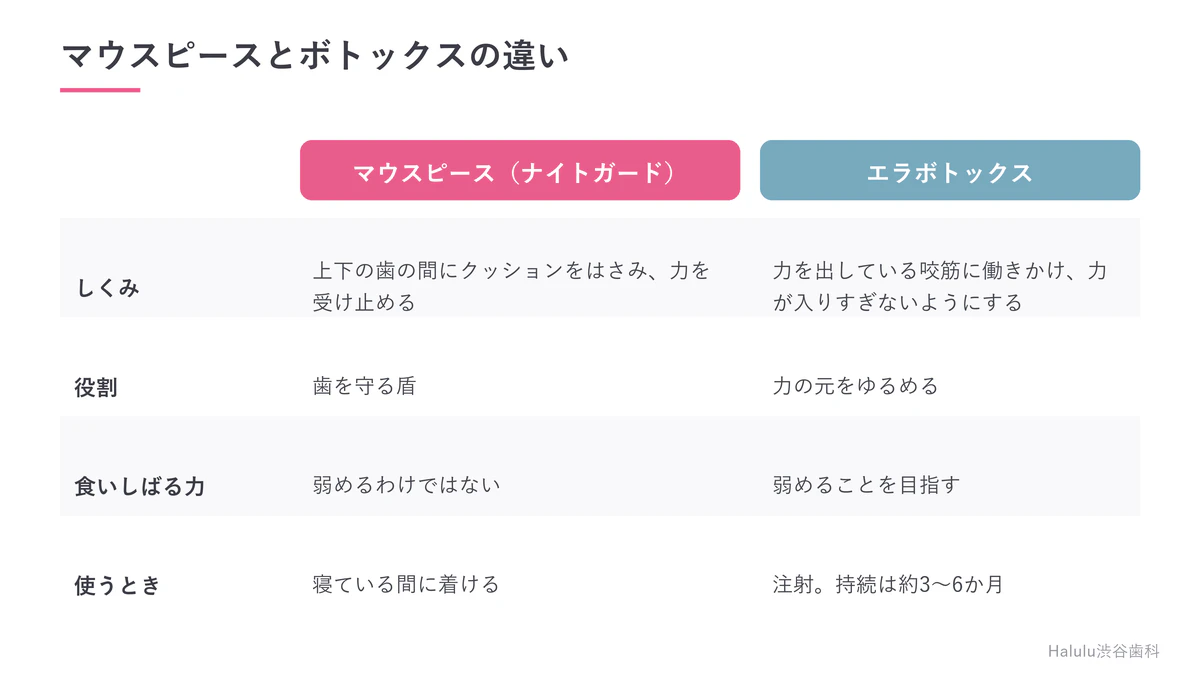
A commonly used measure against clenching and grinding is a mouthguard (night guard) that you wear over your teeth while you sleep. By placing a cushion between the upper and lower teeth, it absorbs the force on your teeth and fillings and prevents wear and chipping. However, it does not weaken the clenching force itself.
Botox, on the other hand, works on the masseter muscle that produces the force, so that too much force does not build up. If the night guard is a "shield that protects your teeth," it may help to think of Botox as something that "relaxes the source of the force."
Which suits you better depends on whether you clench only at night or during the day too, the condition of your teeth and fillings, and whether you have jaw symptoms. In some cases we combine both. You can check the prices of our mouthguards for temporomandibular disorders and teeth grinding in the price list.
How it takes effect and how long it lasts vary from person to person
Botox does not work on the day of the injection. The muscle's strength relaxes gradually. The time it takes to start working and how long the effect lasts vary from person to person, depending on the thickness of the muscle, the strength of the clenching, daily habits, and other factors.
The effect does not last forever, so we decide whether to continue while watching how you respond. Please decide the pace that suits you by talking with your dentist at the consultation.
Side effects and risks
Masseter Botox is an injection treatment, so it carries the following side effects and risks.
- Temporary tiredness in the jaw, or difficulty chewing
- Pain at the injection site
- Swelling
- Bruising
Difficulty chewing and tiredness occur as the muscle's strength relaxes, and in many cases they settle down over time. If chewing hard foods is difficult, it is reassuring to eat softer foods for a while. If symptoms that concern you continue, please do not judge on your own and contact the clinic.
People who should think carefully about receiving it
If you are pregnant or breastfeeding, are being treated for an existing medical condition, or are taking medication, you may not be able to receive Botox, or you may need to think carefully about it. Whether you can receive it depends on your physical condition, so please tell your dentist yourself, even before you are asked.
From consultation to injection
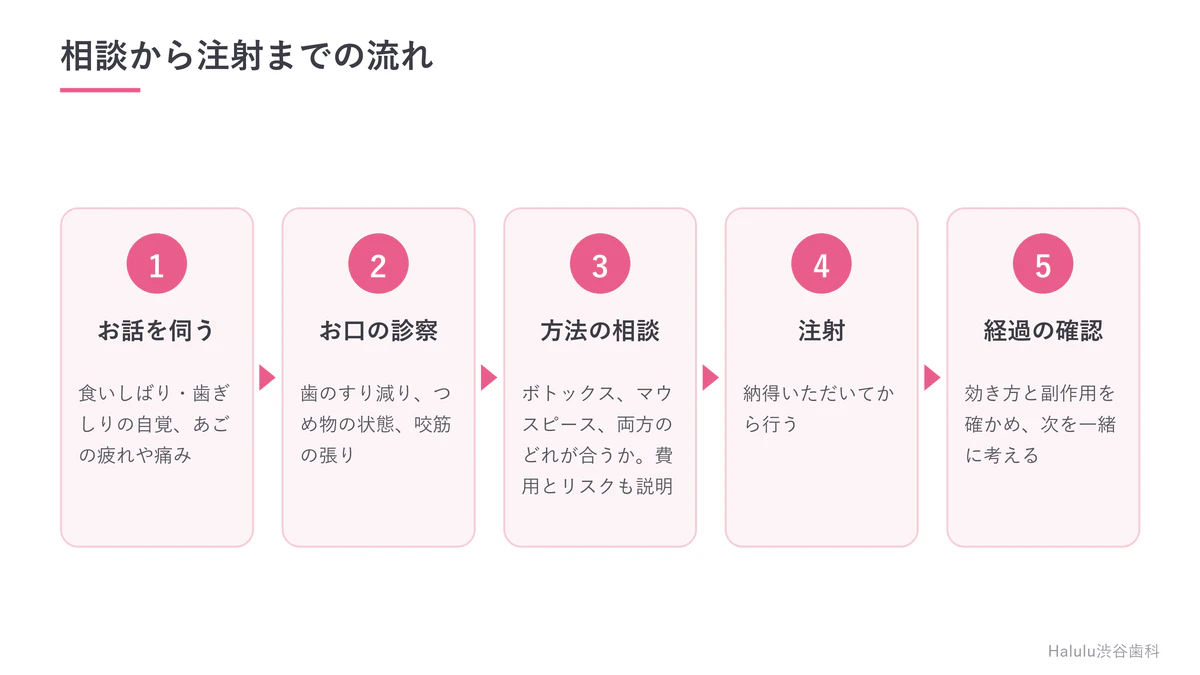
First, we ask whether you are aware of clenching or grinding, and how much jaw tiredness or pain you have. Then we look inside your mouth and check the wear on your teeth, the condition of your fillings, and how tense your masseter is. If you would like to know more about the condition of your teeth and jaw as a whole, you can also have the Oral Dock (comprehensive dental check-up), a detailed examination.
We proceed to the injection only after we have talked about whether Botox seems suitable, whether a mouthguard would be better, or whether both would be best, and after you are satisfied with the cost and risks. After the injection, we check how it is working and whether there are any side effects, and think together about what to do next.
About the drug we use (unapproved drug in Japan)
The product "Rizetox (リズトックス)" used for our botulinum toxin injections is a drug that is not approved in Japan.
- How it is obtained: Under the responsibility of the doctor, it is personally imported through an import agent.
- Approved drugs in Japan: In Japan, there are botulinum toxin products approved for treating wrinkles between the eyebrows and at the corners of the eyes. There are no drugs approved for use on the masseter (jaw angle / clenching), the corners of the mouth, or a gummy smile (the muscle that lifts the upper lip).
- Safety in other countries: Rizetox obtained approval from the Ministry of Food and Drug Safety (MFDS) of South Korea in 2019. In addition, according to the manufacturer's announcement, the 100-unit product under the export name "Hutox" obtained approval from China's National Medical Products Administration (NMPA) in January 2026 for treating wrinkles between the eyebrows. Known side effects of botulinum toxin products include pain, swelling, and bruising at the injection site, a temporary feeling of weaker biting force, and temporary difficulty moving facial expressions.
- Because this is a drug not approved in Japan, even if a serious side effect occurs, it is not covered by the national Relief System for Adverse Drug Reactions.
Effects vary from person to person, and they last about 3 to 6 months. Our clinic offers self-pay (not covered by Japanese health insurance) treatment only, and does not provide insurance-covered treatment. Please check the cost in the price list.
Cost of masseter Botox
Masseter Botox is self-pay (not covered by Japanese health insurance). Our clinic offers self-pay treatment only, and does not provide insurance-covered treatment. Our fees are divided according to the amount of drug used on the masseter (number of units). The prices are listed tax included in the price list, so please check them before you receive treatment. We will suggest which amount suits you after examining the condition of your muscle at the consultation.
We also offer botulinum toxin injections for those who want to lift the corners of the mouth. If you are interested, please see the page on mouth corner Botox (lifting the corners of the mouth).
Frequently asked questions
Does the injection hurt?
Because a needle is inserted, you will feel a small prick. How it feels differs from person to person, and the area may also ache after the injection. If you are worried about pain, please do not hesitate to tell us beforehand.
How long does the effect last?
It depends on the condition of your muscle and the strength of your clenching, so we cannot give a fixed period. If you feel the effect is wearing off, please talk to us at a consultation.
What should I do if I have side effects?
Jaw tiredness, difficulty chewing, swelling, and bruising are often temporary. However, if they last a long time or concern you, please contact the clinic early.
If you want to consult about Botox for clenching in Shibuya
Halulu Shibuya Dental Clinic is a prevention-focused dental clinic in Jinnan, Shibuya. Our policy is to protect the teeth you have now, without cutting them more than necessary. Even when you consult us about clenching or grinding, we talk with a focus on how to protect your teeth and fillings, rather than assuming Botox is the answer. Our director, Dr. Shiho, is a certified dentist of the Japan Dental Botulinum Association.
You can consult us at the same clinic not only about Botox, but also about mouthguards, the Oral Dock, and cleaning for prevention, so you can think about measures against clenching and care for your whole mouth together.
We are a 5-minute walk from Shibuya Station on JR and other lines. Our hours are 10:00 to 18:00 on weekdays (Monday to Friday), by appointment only. On weekends, public holidays, and evenings, we see patients by appointment only on the days a doctor is working. Please check the calendar when you book for details. You can book on the web (accepted 24 hours), by LINE, or by phone (03-5422-3518). If you are bothered by a tired jaw in the morning or worn teeth, please feel free to consult us.
This page is supervised by Dr. Kazuya Shiho, Director and dentist at Halulu Shibuya Dental Clinic.