

"I'd like to try whitening, but there are several courses and I can't decide." We often hear this in counseling. Halulu Shibuya Dental Clinic is a clinic built around the concept of "growing your teeth," and we think about taking good care of the teeth you have now. With whitening too, we value not just making teeth whiter, but checking the condition of your teeth and gums before making a proposal. The goal of Halulu-style whitening is "to let you feel a clear whiteness while keeping sensitivity low." From a dental hygienist's point of view, this article introduces how whitening works, the approach behind Halulu-style whitening, the differences and prices of the 4 courses, points to consider when choosing, and the risks and self-care you should know about.
1. How Whitening Makes Teeth Whiter

1-1. What determines tooth color?
The color of your teeth is seen as a combination of the translucent enamel on the surface and the color of the dentin beneath it. When the enamel is highly transparent, the color of the dentin underneath shows through more easily, and teeth can look more yellow. In other words, tooth color is not determined only by stains on the surface; the nature of the tooth itself also plays a part. The original color differs from person to person, and even if you feel your teeth are "more yellow than other people's," that may well be your natural tooth color.
1-2. The difference from cleaning
In whitening, a agent containing hydrogen peroxide or similar is applied to the tooth surface and breaks down the pigments inside the tooth, bringing out the brightness of the tooth itself. On the other hand, removing stains (staining) on the tooth surface from things like coffee and black tea is "cleaning." It's easy to understand if you think of cleaning as care that returns teeth to their natural color, and whitening as a treatment that makes the tooth color itself brighter.
1-3. How white your teeth become varies from person to person
How white your teeth become depends on your original tooth color and quality, your age, your lifestyle habits, and so on. Even with the same course and the same number of sessions, results vary from person to person. Also, artificial materials such as fillings and crowns do not become whiter with the whitening agent. In counseling, we record your current tooth color, decide on a realistic goal together, and then discuss which course seems to suit you.
2. The 4 Whitening Courses at Halulu Shibuya Dental Clinic
2-1. What Halulu-style whitening aims for
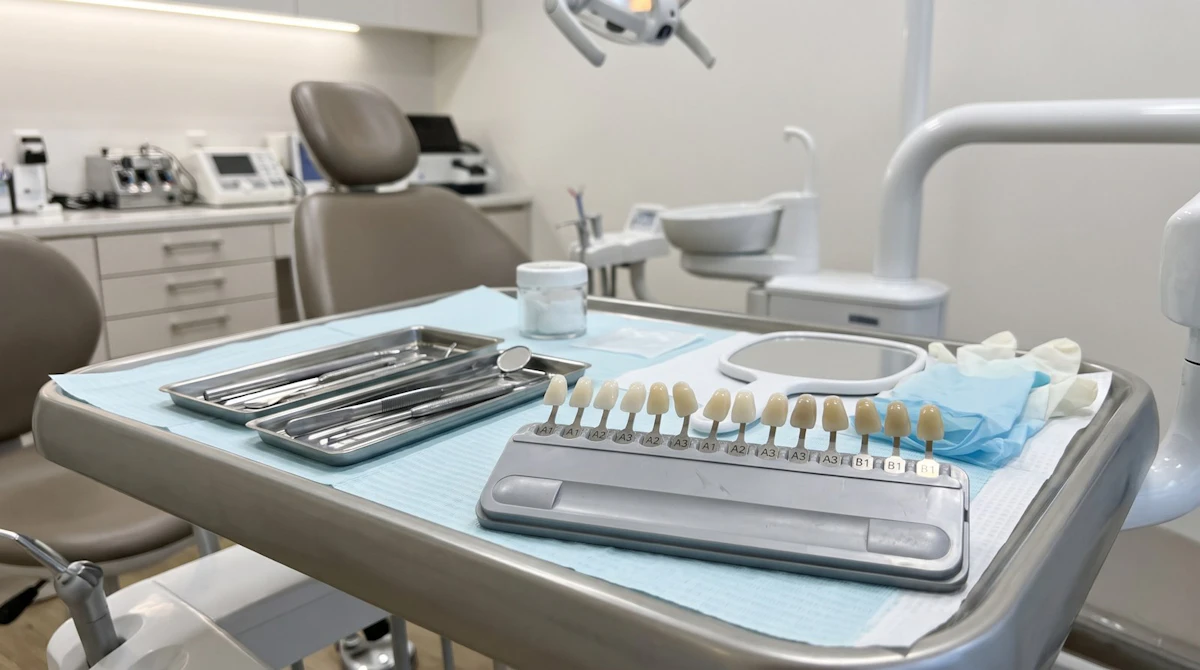
When it comes to whitening, we often hear "I'm worried about sensitivity." The goal of Halulu-style whitening is both low sensitivity and a clear whiteness. To achieve this, we incorporate both measures to reduce sensitivity and approaches to bring out whiteness, before, during and after treatment. Rather than giving up one for the other, the Halulu way is to adjust to the condition of each person's teeth so that both effects work as well as possible. However, how it feels and the final result vary from person to person, and sensitivity may occur.
2-2. The differences between Light, Standard, Premium and Elite
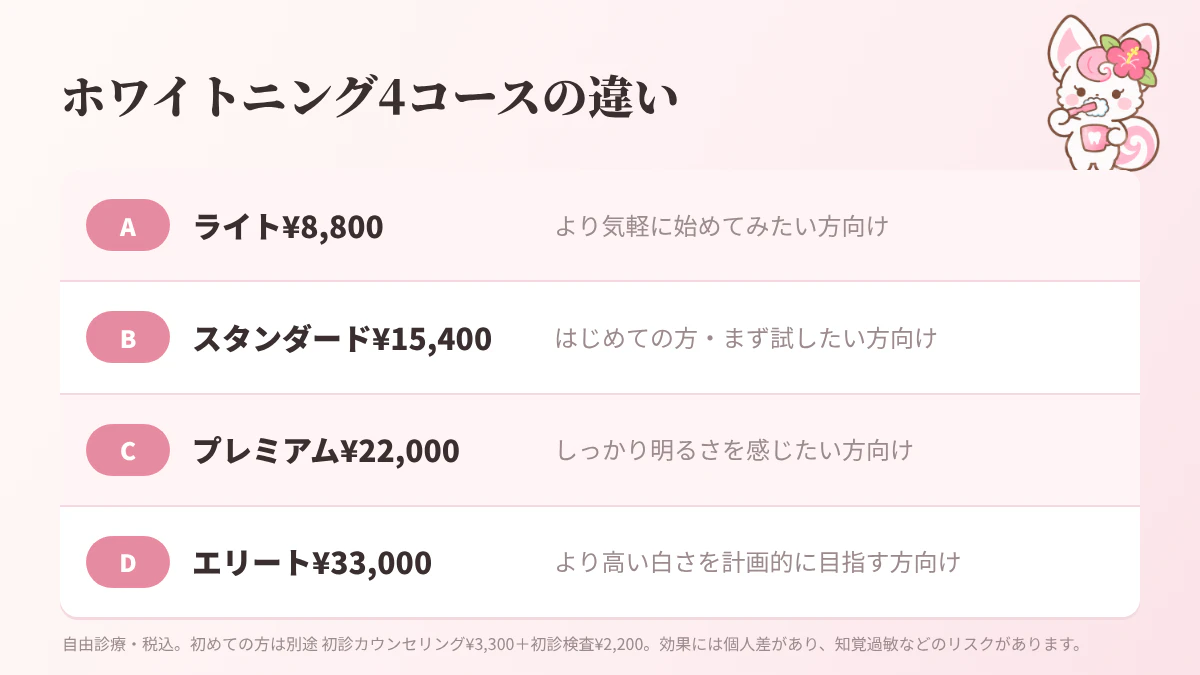
At our clinic, we offer 4 courses to match your target whiteness and your schedule (all self-pay (not covered by Japanese health insurance), tax included). Light, ¥8,800, is for those who want to start whitening more casually. Standard, ¥15,400, is for first-timers and those who want to try how much brighter their teeth become. Premium, ¥22,000, is for those who want to clearly feel the brightness or want to prepare for an event. Elite, ¥33,000, is a course for those who want to aim for a higher level of whiteness or keep stepping up their tone in a planned way.
2-3. Costs for first-time patients
For first-time patients, in addition to the course fee, there is an initial counseling fee of ¥3,300 and an initial examination fee of ¥2,200 (both tax included). The examination checks whether you have any cavities or gum inflammation, and whether you are in a condition to receive whitening. We will explain the specific details of each course (number of light exposures, treatment time, etc.) at counseling, based on your examination results. We have summarized the differences between the 4 courses in a table.
3. 3 Points to Consider When Choosing a Course

3-1. How white do you want your teeth to be?
The course that suits you changes depending on whether you want "teeth that just look naturally bright" or "a clearly noticeable whiteness." If you put your ideal image into words and tell us, it makes it easier for us to make a proposal. Some people picture pure white teeth like a celebrity's, while others are happy if their complexion simply looks brighter. Sharing the whiteness you're aiming for at the start is the first step toward satisfaction.
3-2. By when do you want whiter teeth?
If you have a fixed date, such as a wedding or a photo shoot, we work backward from it to plan the number of sessions and the schedule. Depending on the whiteness you want, we may propose multiple sessions, so we recommend starting with time to spare rather than rushing at the last minute. If you're unsure, another option is to first check how your teeth react with Standard, and then consider the next step.
3-3. The condition of your teeth and gums
If you have cavities or gum inflammation, your teeth may become more sensitive, or the agent may not be usable. For this reason, at our clinic we check at the initial examination whether you are in a condition to receive whitening before we guide you. Keeping your gums healthy also becomes the foundation for enjoying your whiteness for longer. If you have any symptoms that concern you, please feel free to tell us at counseling.
4. Treatment Flow, Risks and Side Effects
4-1. The flow from the first visit to treatment
First, at the initial counseling and examination, we listen to your concerns and wishes, and record the condition of your teeth and gums and your current tooth color. Next is a step to prepare the tooth surface as needed, because if there is dirt on the surface, the agent has difficulty working evenly. In the treatment, we protect the gums, apply the agent, and expose it to light to promote the reaction. The time required per session varies by course, and as a guide it is 45 to 75 minutes for first-time patients and 30 to 60 minutes for return visits. Finally, we check the color and tell you how to spend the rest of the day.
4-2. Risks and side effects you should know about
Whitening is a treatment that does not shave the teeth, but your teeth may temporarily become sensitive (tooth sensitivity) during or after treatment. In most cases it settles down over time, but please talk to us if it continues. If the agent touches your gums, they may also tingle or sting temporarily. In addition, if you have artificial materials in your front teeth, a difference in color may appear, and the color may gradually return over time (relapse).
4-3. When we may not be able to treat you
People who are pregnant or breastfeeding, people with acatalasemia, and people who have cavities that need treatment or severe tooth sensitivity may not be able to receive treatment. Also, depending on the condition of your teeth, it may be better to prioritize things like gum care first. At our clinic, we propose a method that is reasonable for you based on your examination results, so let's start by finding out the current state of your mouth.
5. Self-Care to Keep Your Teeth White
5-1. How to spend the 24 hours after treatment
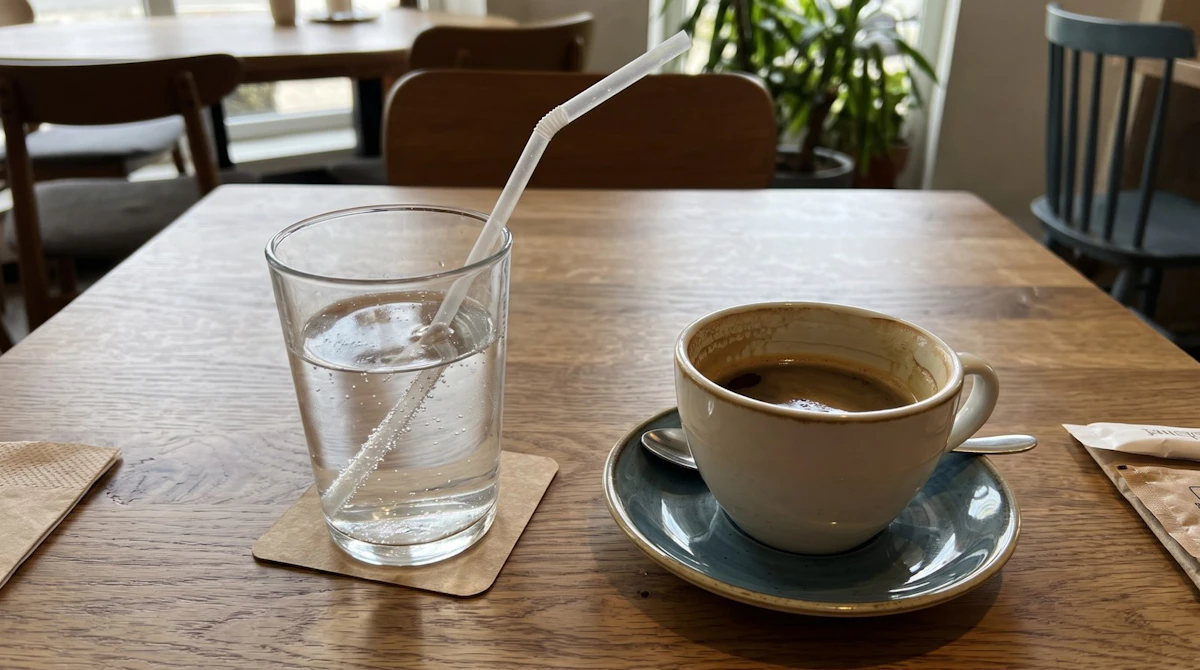
After whitening, your teeth are in a state where they stain easily for a while. For about 24 hours from the day of treatment, try to avoid strongly colored foods and drinks such as coffee, black tea, red wine, curry and soy sauce. Acidic foods and drinks such as lemon and carbonated drinks can also make teeth more sensitive, so please avoid them for a little while. Smoking also causes staining, so we recommend avoiding it during this time. If you're unsure, it's easier to decide by using "something that would stain a white shirt if spilled on it" as a guide.
5-2. Small daily habits and regular care
After that too, small habits such as rinsing your mouth with water after drinking something strongly colored, or using a straw, help keep your teeth white. Also, keeping the tooth surface smooth with regular cleaning makes stains less likely to stick. Protecting the health of your gums also helps protect your smile itself. Along with whiteness, let's keep caring for your whole mouth.
6. Frequently Asked Questions (Q&A)
6-1. Will my teeth feel sensitive during whitening?
They may feel temporarily sensitive during or after treatment. How it feels varies from person to person, and in most cases it settles down over time. For people who are prone to sensitivity, what we can discuss includes adjusting how the agent is used and the interval between sessions.
6-2. How many visits will I need?
It differs depending on the whiteness you're aiming for and your original tooth color. Some people feel a change after 1 session, while in other cases we propose multiple sessions. We decide the number of sessions and the interval together with you while watching how your teeth react.
6-3. Will fillings and crowns also become white?
Artificial materials such as fillings, crowns and dentures do not become whiter with whitening. If you have artificial materials in your front teeth, a difference in color may appear, so please talk to us beforehand at counseling.
Summary
The key to choosing a whitening course is to think about 3 things: "how white you want your teeth to be," "by when," and "the current condition of your teeth." At Halulu Shibuya Dental Clinic, our dental hygienists check the condition of each person's mouth and then propose a plan that is reasonable for you. It's perfectly fine to come even if you're at the stage of "I don't know which course is best." Reservations are accepted through the booking form on our clinic website or by phone, so please feel free to contact us.
About the author of this article
Rinka Sakamori (坂森 琳伽)
Dental hygienist (obtained national qualification in 2017). Representative Director of Ikashika Kyoikukai (General Incorporated Association). Works as a dental hygienist at Halulu Shibuya Dental Clinic.
For details of the menu, see Office Whitening, and for costs, see the price list. If you can't decide which course to choose, you can consult us without choosing a course through Web booking.
Our hours are weekdays (Monday to Friday) 10:00 to 18:00, by appointment only. On weekends, national holidays and evenings, we see patients by appointment only on days when a doctor is in. Please check the calendar at the time of booking for details.
References
This article was supervised by Dr. Kazuya Shiho, Director and dentist of Halulu Shibuya Dental Clinic (date of supervision: November 4, 2026).