
In cavity treatment at Halulu Shibuya Dental Clinic, we precisely remove the decayed part of the tooth and restore the tooth's shape with a filling or a crown. The cost depends on the size of the cavity and the material used for the filling or crown. A guide is listed in our price list. During treatment, we make a point of keeping pain down as much as possible with anesthesia. The earlier you have a cavity checked, the less of the tooth needs to be removed.
Sensitive teeth or dark spots: is it a cavity? Symptoms and how cavities progress
A cavity is a disease in which acid produced by bacteria on the tooth surface gradually dissolves the tooth. At first there is almost no pain, so it is hard to notice on your own, which is the troublesome part.
If you notice any of the following, a cavity may have started.
- Your tooth is sensitive to cold or sweet things, or feels odd when you bite
- There is a hole in your tooth, or a black or brown spot
- Your tooth throbs even when you are doing nothing
If even one of these applies to you, please have it checked at a dental clinic soon.
How a cavity progresses
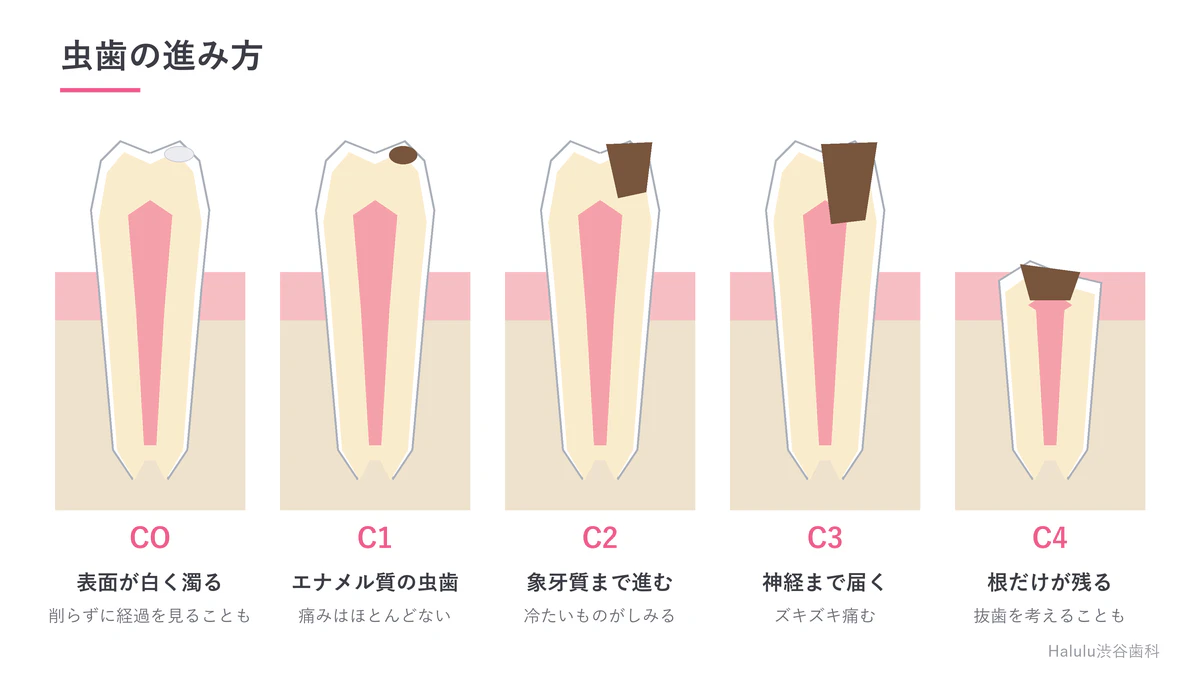
The outermost layer of a tooth is a hard layer called enamel. A cavity starts in this enamel, and the tooth surface becomes cloudy white or turns slightly brown. At this stage there is almost no pain.
When it reaches the dentin inside the enamel, the tooth starts to feel sensitive to cold and sweet things. Dentin is softer than enamel, so the cavity tends to spread sideways inside the tooth. Even if the hole on the surface looks small, it is not unusual for the cavity to have spread widely inside.
When it progresses further and reaches the nerve inside the tooth, the tooth throbs even when you are doing nothing. At this point, simply removing the cavity is not enough to finish treatment, and in many cases treatment of the nerve is also needed.
Finally, the crown of the tooth breaks down and only the root remains. When the nerve dies, the pain goes away for a while, but that does not mean the cavity has healed. If left as it is, it can lead to other problems, such as pus collecting at the tip of the root.
You cannot tell how far a cavity has progressed from pain or appearance alone. Cavities between teeth or under fillings cannot be seen in a mirror, so a dental clinic examines your mouth and, when necessary, confirms with X-rays.
The flow of cavity treatment
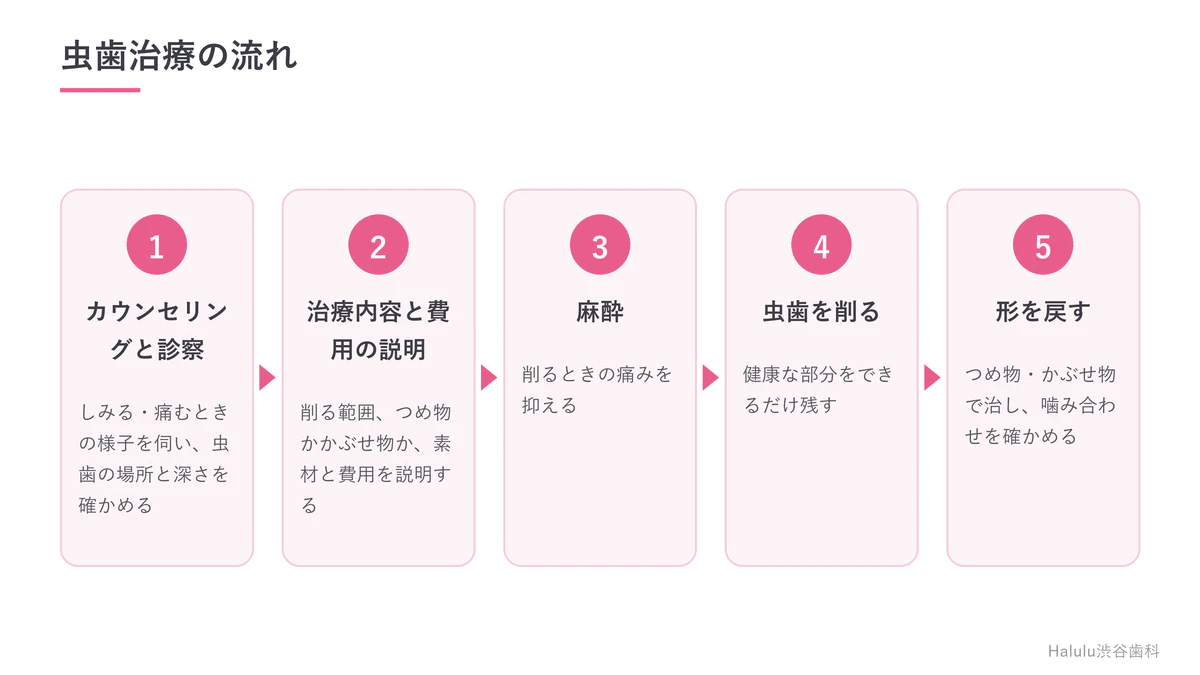
Cavity treatment generally proceeds in the following order. The details change depending on the size and location of the cavity, but knowing the overall flow makes it easier for first-time patients to picture a visit.
Counseling and examination
First, we ask about your concerns, such as which tooth has been sensitive and since when, and when it hurts. Then the dentist examines your mouth and checks the location and depth of the cavity.
Explanation of treatment and costs
Based on the examination results, we explain where and how much will be removed, and whether the tooth will be treated with a filling or a crown. Appearance and cost vary depending on the material, so please feel free to ask about anything you don't understand at this stage. We begin treatment after you are satisfied with the explanation.
Anesthesia
To reduce pain while the tooth is being drilled, we apply anesthesia around the tooth being treated. For a very shallow cavity that can be treated without anesthesia, we decide together after discussing it with you.
Removing the decayed part
What we remove is the part damaged by the cavity. We remove it while determining the extent of the cavity, so that as much of the healthy part as possible is left.
Restoring the tooth's shape with a filling or crown
Restoring the removed area to its original shape is the role of the filling or crown. If the removed area is small, we use a filling; if a large area has been removed, we use a crown that covers the whole tooth. Finally, we check and adjust your bite, and the treatment is finished.
What changes the number of visits?
The number of visits changes with the size and depth of the cavity. If a small cavity is filled directly in your mouth, treatment often finishes in a small number of visits. When we take an impression and make a filling or crown, the number of visits increases because of the wait for it to be made. When the cavity has reached the nerve and nerve treatment is needed, or when you have several cavities, the number of visits also increases accordingly.
What determines the cost of cavity treatment?
The cost of cavity treatment changes mainly depending on the following.
- The size and depth of the cavity
- Whether it is treated with a filling or a crown
- The material used for the filling or crown
- Whether nerve treatment is needed
Even for the same single tooth, treating a shallow cavity with a small filling is very different from treating it with nerve treatment and a crown, and the cost changes accordingly.
At Halulu Shibuya Dental Clinic, we list a guide to the cost of each treatment in our price list. In the price list, cavity treatment is ¥16,500, direct bonding is ¥22,000, ceramic fillings are from ¥55,000, crowns are from ¥88,000 (per tooth), and pulp preservation treatment is ¥44,000 (all tax included). Our clinic offers self-pay (not covered by Japanese health insurance) treatment only and does not provide insurance-covered treatment. We explain how much it will cost in your case after checking the condition of your cavity at the examination. If you are worried about cost, please tell us during the explanation. If a cavity is treated while it is still small, both the area removed and the amount of treatment can be smaller.
Is cavity treatment painful? About anesthesia and pain
Some of you may feel anxious, thinking "dental treatment sounds painful." We use anesthesia when removing a cavity, so pain during treatment can be kept down as much as possible. The anesthetic injection itself has a pricking feeling, and how pain is felt differs from person to person.
If the cavity has progressed close to the nerve and inflammation is strong, anesthesia becomes less effective. Having it checked while it only feels sensitive, rather than waiting until the pain gets strong, keeps the burden of treatment lighter.
If you feel pain during treatment, please don't endure it. Let us know, for example by raising your hand. We will respond by adding anesthesia or taking a break.
What can happen after treatment
Even after treatment is finished, the following may happen. If you know about them in advance, you can respond calmly.
A tooth that has been drilled becomes more sensitive to cold things for a while. The deeper the cavity and the closer the drilled area is to the nerve, the more sensitive it tends to be, but in most cases it settles as days pass. If the sensitivity becomes stronger or changes to a throbbing pain, please contact us soon.
Fillings and crowns may come off when you bite something hard or eat sticky things such as gum. There are also cases where a new cavity forms in the gap between the tooth and the filling and the filling comes off. If one comes off, please don't leave it as it is, and visit us with the filling that came off.
For a tooth with a deep cavity, inflammation may occur in the nerve after treatment and nerve treatment may become necessary, and even for a tooth we judged before treatment could keep its nerve, pain may appear later. If symptoms that concern you continue, please talk to us.
Cleanings to prevent cavities from coming back
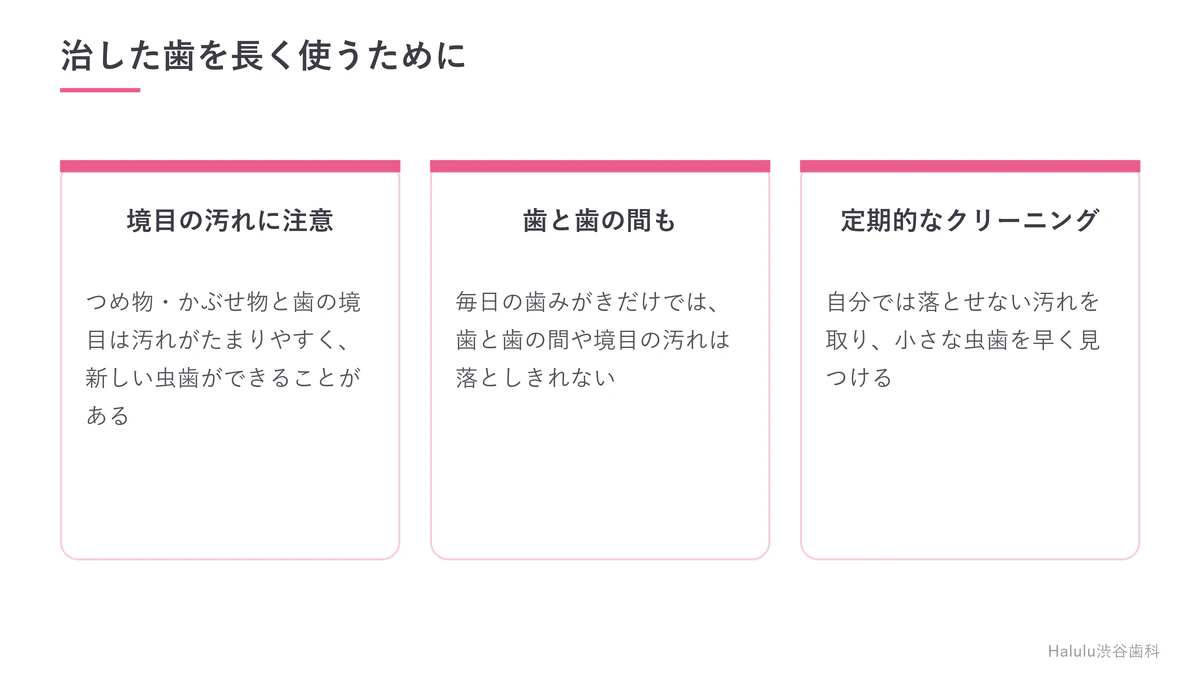
You would like to think that once treatment is finished you can relax, right? However, a tooth that has been treated once is not necessarily safe after that. Dirt easily collects at the boundary between the filling or crown and the tooth, and a new cavity can form from there. To keep a treated tooth for a long time, care after treatment is important.
Daily tooth brushing alone cannot completely remove dirt between teeth and at the boundary. Have regular cleanings at a dental clinic to remove the dirt you cannot remove yourself. If you visit regularly, small cavities can be found early, making it easier to treat them while the amount removed is small.
Halulu Shibuya Dental Clinic is a prevention-focused dental clinic, and even after cavity treatment is finished, we continue to monitor your mouth with Halulu-style cleaning. For those who want a detailed examination of the whole mouth, we also offer a thorough examination called Oral Dock (comprehensive dental check-up).
For cavity treatment consultations in Shibuya, come to Halulu Shibuya Dental Clinic
Halulu Shibuya Dental Clinic is a prevention-focused dental clinic that values protecting the teeth you have now by removing as little of the tooth as possible. In cavity treatment too, we treat with the aim of leaving the healthy parts. The cleanings and Oral Dock (comprehensive dental check-up) after treatment are there to help prevent recurrence.
Our director, Kazuya Shiho, is a dentist who graduated from Tokyo Medical and Dental University (now Institute of Science Tokyo). We explain the treatment details and costs based on the examination results.
The clinic is on the 4th floor of Toyama Building, 1-20-12 Jinnan, Shibuya-ku, a 5-minute walk from Shibuya Station (JR and other lines). Hours are weekdays (Mon to Fri) 10:00 to 18:00, by appointment only. On weekends, public holidays and evenings, we see patients by appointment only on days when a doctor is in. Please check the calendar when you book for details. You can book through the web booking system, which accepts bookings 24 hours a day, as well as by LINE or phone (03-5422-3518).
Please talk to us early, at the stage when your teeth feel sensitive or a dark spot concerns you. You can book online here.
Frequently asked questions
How much does cavity treatment cost?
The cost depends on the size and depth of the cavity and the material used for the filling or crown. A guide for each treatment is listed in our price list. We explain the cost for your own case after checking the condition of your cavity at the examination.
How many visits does cavity treatment take?
The number of visits depends on the size and depth of the cavity and the treatment method. A small cavity often finishes in a small number of visits, and the number increases when we take an impression to make a filling or crown, or when nerve treatment is needed. We explain the approximate outlook for visits after the examination.
Is cavity treatment painful?
We use anesthesia when removing a cavity, so pain during treatment can be kept down as much as possible. The anesthetic injection has a pricking feeling, and how pain is felt varies from person to person. If you feel pain during treatment, please let us know right away, for example by raising your hand.
Is there anything I should be careful about after cavity treatment?
Until the anesthesia wears off, please refrain from eating so that you don't bite your cheek or tongue. A treated tooth may feel sensitive to cold things for a while. If strong pain occurs or a filling comes off, please visit us soon.
This page is supervised by Dr. Kazuya Shiho, Director and dentist at Halulu Shibuya Dental Clinic.