

It is time to consider replacing a silver filling or crown with ceramic when a gap or dark discoloration appears at the edge between the silver and your tooth, when the silver comes off or chips, or when you notice symptoms such as sensitivity or pain when biting. If you are replacing it because of appearance or concern about metal allergies, there is no need to rush. You can choose the timing to suit your own schedule.
Many people wonder, "My silver filling still works. Is it okay to replace it?" In this article, Halulu Shibuya Dental Clinic in Jinnan, Shibuya explains the signs that suggest it is time to consider replacement, cases where there is no need to hurry, and precautions to know before replacing. For details on the characteristics and costs of ceramic as a material, please see our ceramic treatment page.
When Should You Replace Silver Fillings and Crowns with Ceramic? Signs to Consider Replacement
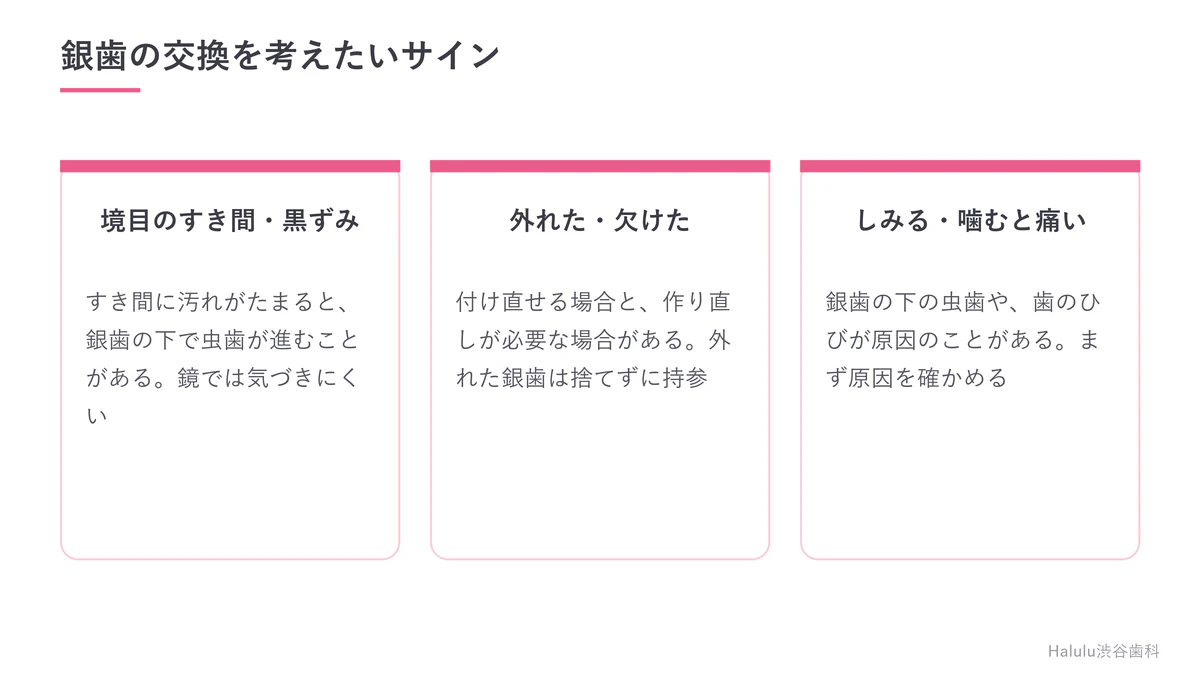
Silver is a durable material, but with long use, changes can appear at the edge where it meets the tooth or in the silver itself. If you notice any of the following signs, it may be time to consider replacement.
There is a gap, a step or dark discoloration at the edge between the silver and the tooth
Silver fillings and crowns are attached to the tooth with dental adhesive (cement). Over the years, this cement may dissolve, or the force of biting may create a tiny gap between the silver and the tooth. If debris collects in the gap, cavities can progress underneath the silver. This is called secondary cavities.
Secondary cavities are hidden under the silver, so they are hard to notice even when you look in a mirror. By the time pain appears, the cavity may have progressed considerably. If the edge looks dark, or floss catches there, please have it examined once.
The silver has come off, chipped or become loose
When a silver filling or crown comes off, there are cases where it can be reattached as it is and cases where it needs to be remade. If the cause is a cavity or a chipped tooth under the silver, that treatment comes first. If it is remade, that is a chance to think about whether to use ceramic. Please do not throw away the piece that came off. Put it in a case or similar container and bring it with you.
If it is left off, the exposed tooth may develop a cavity, or the neighboring teeth and the teeth that bite against it may shift. Please consult us early.
Sensitivity or pain when biting
If a tooth with a silver filling or crown is sensitive or hurts when you bite, a cavity may be progressing under the silver, or the tooth may have a crack. Also, because metal conducts heat easily, the tooth may become more sensitive to cold or hot food and drinks. Treatment differs depending on the cause, so it is important to first find out the cause.
You are concerned about appearance or metal
Some people replace silver because they want to whiten the silver that shows when they smile or talk, because they are bothered by the dark look at the edge along the gums, or because they are worried about metal allergies and want to choose metal-free treatment. In these cases, if there is no problem with the silver, there is no need to rush. You can decide the timing to fit events such as a wedding, a new job or a photo shoot.
Whether you have a metal allergy can be checked with allergy testing at a dermatology clinic or similar. If this is a concern for you, please let us know at your appointment.
If There Is No Problem with Your Current Silver, Do You Need to Replace It Right Away?
If there is no cavity or gap at the edge and you can bite firmly, there is no need to replace the silver in a hurry. When silver is removed and ceramic is placed, the tooth may need to be trimmed to shape it so the ceramic fits. Please be aware that replacing silver that has no problems also involves this burden.
What our clinic values is protecting your existing teeth as much as possible, with a focus on prevention. Even if appearance is a concern, we examine the condition of the silver and the tooth and then think together with you about whether to replace it. Even silver without symptoms can have secondary cavities that are hard to notice yourself, so it gives peace of mind to check the edge regularly with cleaning or an Oral Dock (comprehensive dental check-up).
If you have many silver teeth, do you replace them all at once?
There is no need to replace everything at once. It is generally done in order, starting with the teeth that need treatment, such as teeth with a cavity at the edge or teeth where the silver is coming loose. If you want to improve appearance, you can also choose to start with the teeth that show when you smile. Please talk with us about the order, taking cost and the number of visits into account.
What to Know Before Replacing Silver with Ceramic
Once it is removed, the treatment may change
What is under the silver cannot be seen until it is removed. If a cavity is found when it is removed, the cavity is removed first and then the ceramic is made. If the cavity has progressed close to the nerve, or if root canal treatment is needed, the number of visits increases. For ways to keep the nerve as much as possible, please also see our vital pulp therapy page.
If you grind or clench your teeth, take steps to prevent breakage
Ceramic is a material that resists color change and does not easily pick up stains. On the other hand, it can crack or chip when strong force is applied. For people who grind or clench their teeth, we may recommend a mouthguard worn during sleep. The process and cost of making a mouthguard are summarized in our column on mouthguards for teeth grinding and clenching.
If you are considering whitening, do it first
The color of ceramic does not change even if you have whitening after it is placed. If you want whiter teeth, having whitening first and then matching the ceramic to the whitened tooth color makes a difference in color less likely. Office whitening is also available at our clinic.
For a small filling, there is also a method without taking an impression
If you want to replace a small silver filling with a white one, there is also a method called direct bonding, in which the tooth is restored with a white material on the same day without taking an impression. Which method and material suit you is decided by examining the size of the cavity, your bite, whether you grind your teeth and other factors.
The Process of Replacing Silver with Ceramic and the Approximate Number of Visits
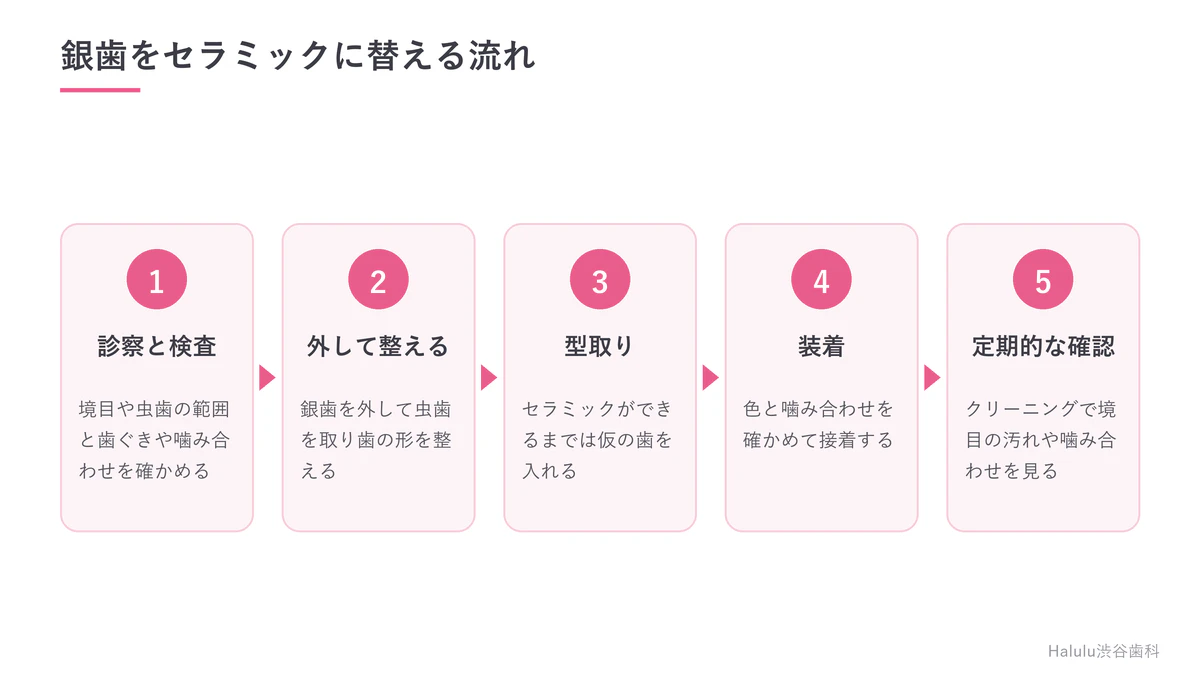
When we replace silver with ceramic at our clinic, we proceed as follows.
- Examination and tests: We check the edge of the silver, the extent of the cavity, the tooth roots and gums, and your bite, and explain the grade and cost.
- Removing the silver and shaping the tooth: We remove the silver, remove the cavity, and shape the tooth so the ceramic fits.
- Impression: This is the stage where an impression of your tooth is taken and the ceramic is made. A temporary tooth is placed until it is ready.
- Placement: We check the color and bite, and then bond the ceramic in place.
- Regular check-ups: At your cleaning, we check for debris at the edge and your bite.
In general, 2 to 3 visits from the impression to placement is a guide. If the cavity was deep when the silver was removed, or if root canal treatment is needed, the number of visits increases. We will tell you the outlook for your own case at your examination.
Costs and Risks You Should Know About
Ceramic fillings and crowns are self-pay (not covered by Japanese health insurance). Our clinic offers self-pay treatment only and does not provide insurance-covered treatment. The costs are as follows (all tax included).
- Initial consultation fee: ¥5,500 (includes counseling and basic examination)
- Crowns (front teeth): Standard ¥165,000 / Premium ¥198,000 / Elite ¥297,000
- Crowns (back teeth): Standard ¥88,000 / Premium ¥110,000 / Elite ¥132,000
- Fillings: Standard ¥55,000 / Premium ¥66,000 / Elite ¥79,200
All prices are shown per tooth. The material (zirconia, e.max, etc.) is chosen by the dental technician to suit the condition of your tooth, and the price is the same whichever is used. Payment is taken before the dental prosthesis is ordered (advance payment).
Self-pay treatment may be eligible for the medical expense deduction. Please check the latest fees on our price list.
Before you undergo treatment, please also check the following points.
- The tooth needs to be trimmed in order to place ceramic.
- It can crack or chip when strong force is applied.
- Ceramic itself does not get cavities, but cavities can form at the edge where it meets the tooth. Daily tooth brushing and regular cleaning are essential.
- The tooth may be sensitive for a while after trimming.
- If a cavity is found when the silver is removed, the treatment and the number of visits may change.
Frequently Asked Questions
After how many years should silver fillings and crowns be replaced?
There is no set number of years after which they should be replaced. A good guide for considering replacement is when changes appear, such as a gap at the edge, a cavity, or the silver coming off or chipping. Because these changes are hard to notice yourself, we recommend having them checked regularly at an examination.
Can I replace silver with ceramic even if it does not hurt?
Yes, it is possible. Some people replace it because of appearance or concern about metal allergies. However, the tooth may be trimmed even when replacing silver that has no problems, so let's look at the condition of your tooth first and think together about whether to replace it.
How long will ceramic last after I replace the silver?
It varies depending on your bite, whether you grind your teeth, and how well you care for your teeth, so we do not give a uniform number of years. To help you use it for a long time, we regularly check for debris at the edge and your bite during cleaning.
Can I replace silver with white teeth using insurance?
Because our clinic offers self-pay treatment only, we do not provide insurance-covered fillings or crowns. At dental clinics that provide insurance-covered treatment, white crowns may be made under insurance depending on the tooth location and conditions.
Does it hurt when the silver is removed?
When removing silver or trimming the tooth, we use anesthesia as needed before proceeding. If you feel pain during treatment, please tell us right away. After the anesthesia wears off, the tooth may be sensitive for a while, or biting may feel uncomfortable.
If You Want to Consult About Replacing Silver with Ceramic in Shibuya
Halulu Shibuya Dental Clinic is on the 4th floor of the Toyama Building in Jinnan, Shibuya-ku, a 5-minute walk from Shibuya Station (JR and other lines). Our director is Kazuya Shiho, a dentist who graduated from Tokyo Medical and Dental University (now Institute of Science Tokyo). We value care that focuses on prevention and protects your existing teeth as much as possible. What we consider just as important as making your teeth white is that you can use those teeth for a long time.
Our hours are 10:00 to 18:00 on weekdays (Monday to Friday), by appointment only. On weekends, public holidays and evenings, we see patients by appointment only on days when a doctor is in. You can book on the web (accepted 24 hours), and we also accept bookings by LINE and by phone (03-5422-3518). If this is your first visit, please start with our initial consultation (initial consultation fee ¥5,500) and tell us about the condition of your silver and your wishes.
Book online at Halulu Shibuya Dental Clinic here
This article was supervised by Dr. Kazuya Shiho, director and dentist at Halulu Shibuya Dental Clinic.