
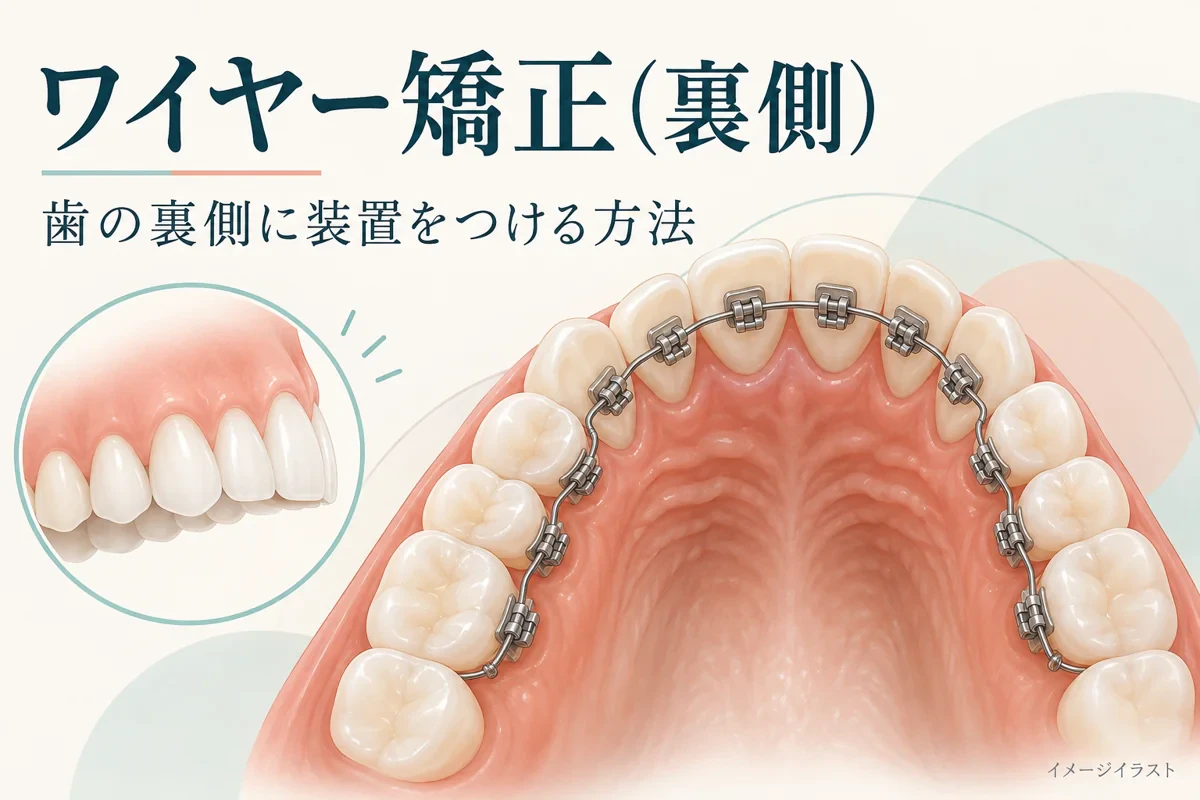
Lingual braces (behind-the-teeth braces) are an orthodontic method in which brackets and wires are attached to the back (tongue side) of the teeth to move them. Because the appliance is almost invisible from the front, they are chosen by people whose work puts them in front of others and by people who do not want others to know they are having orthodontic treatment. The appliance stays in place, so unlike clear aligners you do not need to manage how many hours you wear it yourself. The cost for adults is ¥1,350,000 (tax included).
Differences from braces on the front of the teeth
Lingual braces | Front-side wire braces | |
|---|---|---|
Appearance | Almost invisible from the front | Visible when you talk or smile |
Getting used to them | The tongue touches the appliance, so difficulty speaking and a feeling of discomfort are common | The appliance tends to rub against the inside of the lips and cheeks |
Tooth brushing | Hard to see in a mirror, so it takes some getting used to | You can brush while checking in a mirror |
Cost (adults) | ¥1,350,000 | ¥850,000 |
Because lingual braces are made to fit the shape of the back of each person's teeth, they cost more than front-side braces and may take longer. Let's choose a method you are comfortable with together, taking cost and duration into account.
Who they suit
- People who work in customer service or speak in front of others and do not want to show the appliance
- People who plan to have photos taken during treatment, such as at a wedding
- People who find it hard to manage wearing aligners for set hours each day
Treatment flow and duration
- Orthodontic consultation (¥0)
- Detailed examination and diagnosis (orthodontic diagnosis ¥33,000): We carry out the pre-treatment examination and make a treatment plan.
- Making and attaching the appliance: The appliance is made to fit the back of your teeth and bonded in place.
- Visits and adjustments: We move your teeth while adjusting the wire regularly.
- Retention: After the appliance is removed, a retainer is used to keep your teeth in position.
The treatment period varies depending on your teeth, and is generally about 1 to 3 years, plus a retention period. We will explain the outlook at the time of diagnosis.
What commonly happens while you get used to them
- Because the tongue touches the appliance, for a while after it is fitted you may find it hard to pronounce sounds such as the S and T lines of Japanese.
- The tip or sides of the tongue may rub against the appliance and cause mouth sores. We may give you protective wax.
- Because the back of the teeth is hard to see in a mirror, we will practice brushing methods together.
Cost
- Orthodontic consultation: ¥0
- Orthodontic diagnosis: ¥33,000
- Adult orthodontics (front-side wire braces): ¥850,000
- Adult orthodontics (lingual braces): ¥1,350,000
- Adult clear aligner treatment: ¥960,000
- Children's orthodontics: ¥450,000
- Children's clear aligner treatment: ¥550,000
- Adjustment fee: ¥5,500
Our clinic offers self-pay (not covered by Japanese health insurance) treatment only and does not provide insurance-covered treatment. All prices shown include tax. Self-pay treatment may be eligible for the medical expense deduction. For the latest fees, please check the price list.
Risks and side effects you should know about
- When the appliance is first fitted and after adjustments, you may feel a sensation of the teeth being loose, along with pain or discomfort.
- Plaque tends to remain around the appliance, and if brushing is inadequate, cavities and gum inflammation are more likely to occur.
- The roots of the teeth may become shorter, or the gums may recede.
- The treatment period may become longer than planned depending on how the teeth move and how regularly you attend visits.
- If you do not use a retainer after treatment, your teeth may move back to their original position.
Frequently asked questions
Is it really invisible?
The appliance is rarely visible when seen from the front. It may be slightly visible when you open your mouth wide or when someone looks up at you from below.
How long does it take to get used to difficulty speaking?
It varies from person to person, but most people find that their tongue gets used to the appliance in a few weeks or so, and the difficulty speaking becomes less noticeable.
Are you less likely to get cavities with lingual braces?
The back of the teeth is a place where saliva flows easily, but if plaque remains around the appliance, you can still get cavities. Regardless of the type of appliance, tooth brushing and regular cleaning are important.
Can I have lingual braces on the upper teeth only?
There is also a method of placing the appliance on the back of the more noticeable upper teeth and on the front of the lower teeth. Please talk to us, taking your teeth and the cost into account.
If you are considering lingual braces in Shibuya
Halulu Shibuya Dental Clinic is on the 4th floor of the Toyama Building in Jinnan, Shibuya-ku, a 5-minute walk from Shibuya Station (JR and other lines). The director is dentist Kazuya Shiho, a graduate of Tokyo Medical and Dental University (now Institute of Science Tokyo). We focus on prevention and value care that protects your existing teeth as much as possible.
Hours are 10:00 to 18:00 on weekdays (Monday to Friday), by appointment only. On weekends, public holidays and evenings, we see patients by appointment only on days when a doctor is working. Please check the calendar at the time of booking for details. You can book on the web (24 hours), and we also accept bookings by LINE or phone (03-5422-3518). If it is your first visit, please start with the first-visit counseling (first-visit fee ¥5,500), where we listen to your concerns.
Book at Halulu Shibuya Dental Clinic online here
This page was supervised by Dr. Kazuya Shiho, director and dentist at Halulu Shibuya Dental Clinic.