
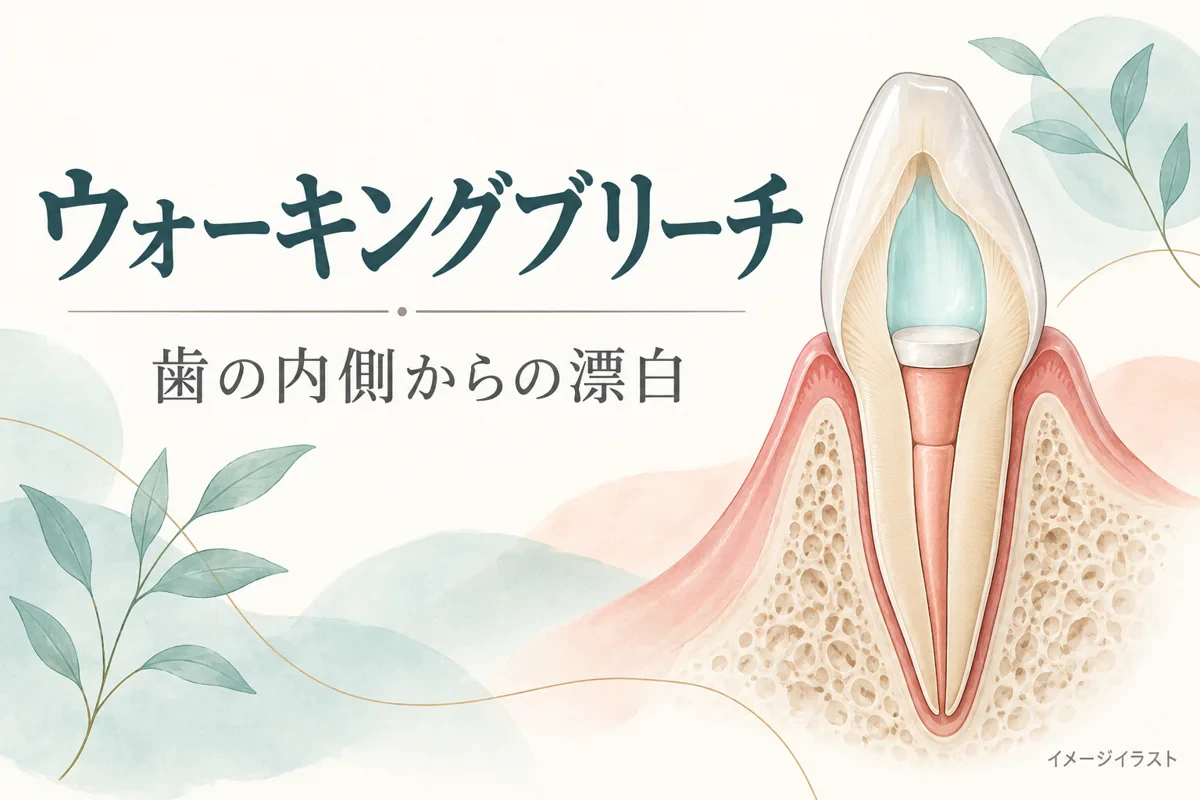
Walking bleach is a method for whitening a tooth from the inside when it has darkened after its nerve was removed, or after the nerve died from a knock or impact. Regular whitening works on the surface of the tooth, so a tooth that is discolored from the inside may not become white easily. If you have had whitening but just one tooth did not become white, this method may suit you. In walking bleach, a bleaching agent is placed inside the tooth through a small hole on the back of the tooth, and the agent is replaced at each visit to whiten the tooth gradually. The cost is ¥33,000 (tax included).
How It Differs from Regular Whitening
Walking bleach | Regular whitening | |
|---|---|---|
Target teeth | Teeth whose nerve has been removed, or teeth whose nerve has died | Teeth with a living nerve |
Where the agent works | Inside the tooth | Surface of the tooth |
Number of teeth | Each discolored tooth, one at a time |
Who It Is For
- People who have one darkened tooth that bothers them when they smile
- People with a tooth whose nerve has been removed and which did not become white with regular whitening
- People who do not want a discolored tooth to be ground down a lot for a crown or similar restoration
Treatment Flow
- Examination and tests: We use an X-ray to check whether the root canal treatment has been completed properly. If the root canal treatment is inadequate, it may need to be redone first.
- Placing the agent: We make a small hole on the back of the tooth, place the bleaching agent, and seal it.
- Replacing the agent: You visit once every few weeks, and we replace the agent while checking the color.
- Finishing: Once the tooth reaches a color that blends in with the surrounding teeth, we remove the agent and fill the hole.
The number of visits needed until the tooth becomes white depends on the degree of discoloration. We will tell you the outlook at the examination.
Cost
- Walking bleach: ¥33,000
Our clinic offers self-pay (not covered by Japanese health insurance) treatment only and does not provide insurance-covered treatment. All prices shown include tax. Self-pay treatment may be eligible for the medical expense deduction. Please check the latest fees on the price list.
Risks You Should Know About
- A tooth whose nerve has been removed is naturally brittle and may break easily even after treatment. Please be careful when biting hard foods.
- In rare cases, resorption (dissolving) of the outer side of the tooth root has been reported, so we check with X-rays regularly even after treatment.
- How white the tooth becomes varies from person to person, and the color may return over time.
- Depending on the cause of the discoloration, the tooth may not become white enough. In that case, we will suggest other methods such as a crown.
FAQ
How white will the tooth become?
It depends on the cause and degree of the discoloration. We proceed while checking the color, with the goal of blending in with the color of the surrounding teeth.
Does it hurt?
Because it is done on a tooth whose nerve has been removed, you do not often feel strong pain when the agent is placed. If you feel any discomfort in the gums or when biting, please let us know.
Will the whiteness last forever?
Over time, the color may gradually return. If it starts to bother you, please talk to us about repeating the procedure.
Which is better, walking bleach or a crown?
Walking bleach is a method that avoids grinding the tooth down a lot. If the tooth is badly chipped, or if it does not become white enough, a crown may suit you better.
Why is only one front tooth dark?
A tooth whose nerve has been removed, or whose nerve has died from a knock or impact, may darken from the inside over time. Cavities or fillings can also be the cause, so we first check the cause at the examination.
How many visits are needed?
You visit once every few weeks, and we replace the agent while checking the color. The number of visits depends on the degree of discoloration. We will tell you the outlook at the examination.
How much does it cost?
It is ¥33,000 (tax included). Our clinic offers self-pay (not covered by Japanese health insurance) treatment only and does not provide insurance-covered treatment. If other treatment is needed first, such as redoing a root canal treatment, we will explain it in advance. Please check the latest fees on the price list.
Can I have it on a tooth with a living nerve?
Walking bleach is for teeth whose nerve has been removed or has died. For yellowing of a tooth with a living nerve, regular whitening is suitable. Which one suits you is confirmed at the examination.
Consult Us About Darkened Teeth in Shibuya
Halulu Shibuya Dental Clinic is on the 4th floor of the Toyama Building in Jinnan, Shibuya-ku, a 5-minute walk from Shibuya Station (JR and other lines). Our director is dentist Kazuya Shiho, a graduate of Tokyo Medical and Dental University (now Institute of Science Tokyo). We value care centered on prevention that protects your existing teeth as much as possible. Even if only one tooth is discolored, please feel free to consult us.
Our hours are 10:00 to 18:00 on weekdays (Monday to Friday), by appointment only. On weekends, public holidays and evenings, we see patients by appointment only on days when a doctor is in. Please check the calendar when booking for details. You can book on the web (accepted 24 hours), and also by LINE or phone (03-5422-3518). If this is your first visit, please start with the first-visit counseling (first-visit fee ¥5,500), a time for us to hear your concerns.
Book online with Halulu Shibuya Dental Clinic here
This page was reviewed by Dr. Kazuya Shiho, director and dentist at Halulu Shibuya Dental Clinic.