
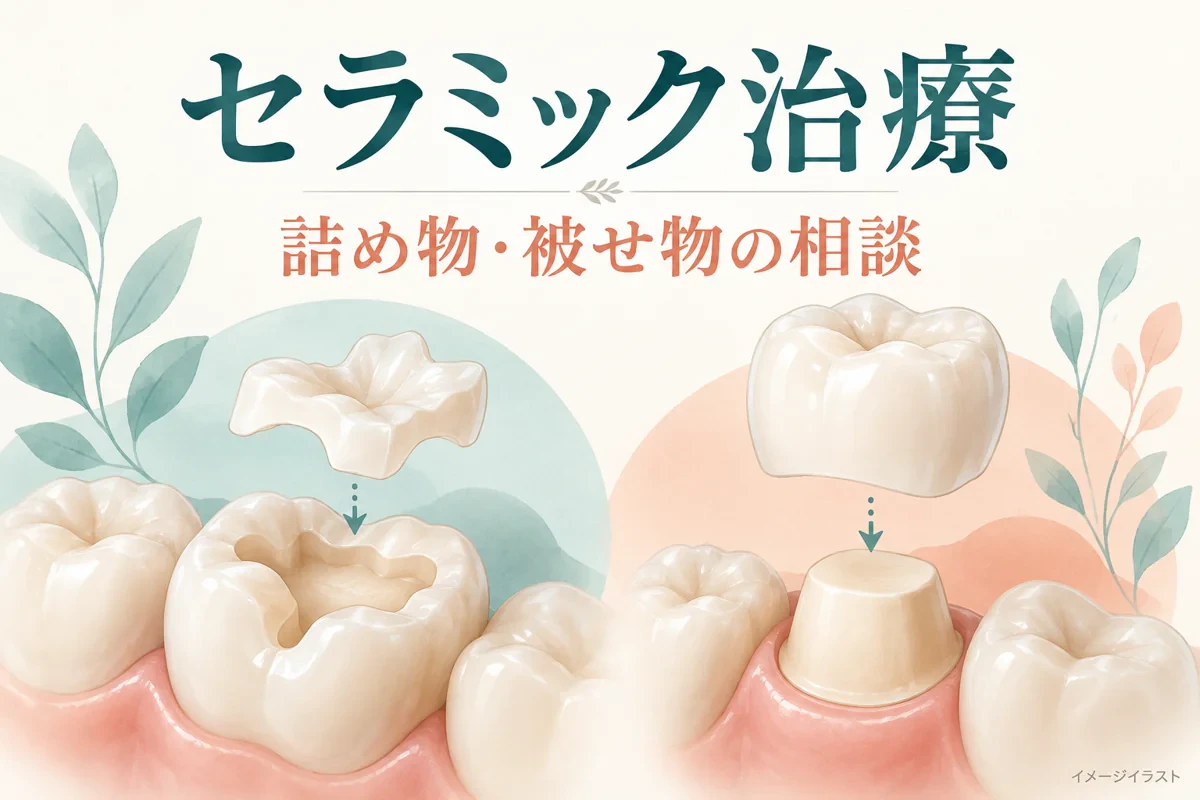
Ceramic is a white, porcelain-like material used for fillings and crowns after a cavity has been treated. Its main features are that it can reproduce a color and translucency close to natural teeth, that its surface is smooth and resists stains and plaque, and that it contains no metal. It is a type of cosmetic dental treatment aimed at improving the appearance of your teeth, and it is self-pay (not covered by Japanese health insurance). At our clinic, ceramic fillings and crowns are available in 3 grades: Standard, Premium and Elite. The cost per tooth starts from ¥55,000 for fillings, from ¥88,000 for crowns on back teeth, and from ¥165,000 for crowns on front teeth (all tax included). This page explains how ceramic differs from other materials, the treatment process, the cost, and the risks we would like you to know about.
How Ceramic Differs from Silver Teeth and Plastic
Fillings and crowns are mainly made from metal (silver teeth), dental plastic (resin) or ceramic. They differ as follows.
Material | Appearance | Main features |
|---|---|---|
Metal (silver teeth) | Silver and noticeable | Strong, but not suited to people concerned about metal allergies. The edge along the gum may look dark |
Plastic | White | Makes it easier to keep the amount of tooth removed small. Over time it tends to change color or wear down |
Ceramic | Close to natural teeth | Resists color change and stains. It may crack if strong force is applied |
For small cavities, there is also a method called direct bonding, which treats the tooth with a white material on the same day without taking an impression. Which material suits you is decided together, after we look at the size of the cavity, your bite, and whether you grind your teeth. Please also tell us if you want to stop using silver teeth or want your restorations to be as inconspicuous as possible.
Who Comes to Us for This
- People who want to replace silver teeth that show when they smile or talk with white teeth
- People who are bothered by discoloration of a white filling they had placed earlier
- People who are concerned about metal allergies and want a treatment that does not use metal
- People who have had a cavity come back under a filling and want to choose a material that resists plaque
Treatment Process and Estimated Number of Visits
- Examination and tests: We check the extent of the cavity, the condition of the tooth roots and gums, and your bite, and explain the grades and costs.
- Shaping the tooth: We remove the cavity and shape the tooth so the ceramic will fit.
- Impression: We take an impression of your tooth and the ceramic is made. A temporary tooth is placed until it is ready.
- Placement: We check the color and bite, then bond the ceramic in place.
In general, 2 to 3 visits from the impression to placement is a guide. If the cavity has progressed close to the nerve, the number of visits increases. If treatment of the foundation or root canal treatment is needed, we refer you to another clinic. We will tell you what to expect at your examination.
The period from shaping the tooth to placement is about 2 weeks or longer as a guide.
If you would also like whitening of your own teeth, please talk to us before the ceramic color is decided. If you plan to whiten first, we will guide you on a treatment schedule, with the aim of finishing at least 2 weeks before the color matching.
Cost
- First visit fee: ¥5,500 (includes counseling and basic examination)
- Crown (front tooth): Standard ¥165,000 / Premium ¥198,000 / Elite ¥297,000
- Crown (back tooth): Standard ¥88,000 / Premium ¥110,000 / Elite ¥132,000
- Filling: Standard ¥55,000 / Premium ¥66,000 / Elite ¥79,200
- Veneer (front tooth): ¥165,000 (the surface of the tooth is thinly shaped and ceramic is bonded on to adjust its shape and color)
All prices are per tooth. The material (zirconia, e.max, etc.) is chosen by a dental technician to suit the condition of your tooth, and the price does not change whichever is used. Payment is taken before the dental prosthesis is ordered (prepayment, by credit card). Dental loans (EPOS and Suruga) are also available. Please ask if you would like to use one.
Our clinic offers self-pay treatment only and does not provide insurance-covered treatment. All prices shown include tax. Self-pay treatment may be eligible for the medical expense deduction. Please check the price list for the latest fees.
Cost Examples for Treating Several Teeth
For 2 back-tooth crowns at the Standard grade, the crown portion is ¥88,000 × 2 teeth = ¥176,000 (tax included). For 2 front-tooth crowns at the Standard grade, the crown portion is ¥165,000 × 2 teeth = ¥330,000 (tax included).
The crown fee includes a temporary tooth and anesthesia. The above are calculation examples for the crown portion only and are not a total estimate including examination and tests. If treatment of the foundation or root canal treatment is needed, we refer you to another clinic. The treatment cost at the referred clinic is not included in these examples.
Risks We Would Like You to Know About
- To place ceramic, your tooth needs to be shaved down.
- It may crack or chip if strong force is applied. For people who grind or clench their teeth, we may recommend a mouthguard to wear during sleep.
- Ceramic itself does not get cavities, but cavities can form at the edge where it meets the tooth. Daily brushing and regular cleanings are essential.
- After the tooth is shaved, it may be sensitive for a while.
Frequently Asked Questions
How long does ceramic last?
It varies depending on your bite, whether you grind your teeth, and how well it is cared for, so we do not give a single number of years. To help it last, we regularly check the plaque at the edge and your bite during cleanings.
Can I replace my current silver teeth with ceramic?
Yes, you can. However, a cavity may have progressed under the silver tooth, so the treatment may change once it is removed. First, we check the condition at an examination.
Can I get white teeth with insurance?
Our clinic offers self-pay treatment only, so we do not provide insurance-covered fillings or crowns. At dental clinics that provide insurance-covered treatment, white crowns may be covered by insurance depending on the location of the tooth and other conditions.
Is there pain during treatment?
When we shape your tooth, we use anesthesia as needed beforehand. If you feel pain during treatment, please tell us right away. After the anesthesia wears off, your tooth may be sensitive for a while, or biting may feel uncomfortable.
Does the material differ between front and back teeth?
It can. What we prioritize when choosing is appearance for front teeth and strength against biting force for back teeth. After checking your bite, we suggest a material that suits each tooth.
If You Are Considering Ceramic Treatment in Shibuya
Halulu Shibuya Dental Clinic is on the 4th floor of the Toyama Building (遠山ビル) in Jinnan, Shibuya-ku, a 5-minute walk from Shibuya Station (JR and other lines). Our director is Kazuya Shiho, a dentist who graduated from Tokyo Medical and Dental University (now Institute of Science Tokyo). We focus on prevention and value care that protects your existing teeth as much as possible. Making your teeth white matters, and being able to use those teeth for a long time is just as important a goal.
Our hours are 10:00 to 18:00 on weekdays (Monday to Friday), by appointment only. On weekends, public holidays and evenings, we see patients by appointment only on days when a doctor is in. Please check the calendar when booking for details. You can book on the web (accepted 24 hours), and also by LINE or phone (03-5422-3518). If it is your first visit, please start with the first-visit counseling (first visit fee ¥5,500), where we listen to your concerns.
Book online at Halulu Shibuya Dental Clinic here
This page was supervised by Kazuya Shiho, director and dentist of Halulu Shibuya Dental Clinic.
References
- Akiba et al. (秋葉 陽介ほか), "Management of Patients with Dental Metal Allergy" (Journal of the Japan Prosthodontic Society, Vol. 14, 2022)
- Sailer I, et al. All-ceramic or metal-ceramic tooth-supported fixed dental prostheses (FDPs)? Part I: Single crowns (Dent Mater, 2015)
- Paolone G, et al. Color Stability of Polymer-Based Composite CAD/CAM Blocks (Polymers, 2023)
- Dionysopoulos D, et al. Wear of contemporary dental composite resin restorations (Restor Dent Endod, 2021)
- Lee BC, et al. Initial bacterial adhesion on resin, titanium and zirconia in vitro (J Adv Prosthodont, 2011)
- Guess PC, et al. Influence of preparation design and ceramic thicknesses on fracture resistance and failure modes of premolar partial coverage restorations (J Prosthet Dent, 2013)
- Alenezi A, et al. Secondary caries in fixed dental prostheses: Long-term clinical evaluation (Clin Exp Dent Res, 2023)
- Yadav K, et al. Dentin hypersensitivity following tooth preparation (J Nat Sci Biol Med, 2014)
- Alaida WS, et al. Biomechanical and Occlusal Factors Influencing the Longevity of Single-Unit Restorations (Cureus, 2025)