

"I notice my mouth is open." "My mouth feels completely dry when I wake up in the morning." Have you had these experiences? In fact, they can be related to your tongue position and how you use the muscles around your mouth. From a dental hygienist's point of view, this article introduces the correct tongue position, how mouth breathing affects your mouth, self-checks and self-care you can start today, and the MFT (myofunctional therapy) we offer at Halulu Shibuya Dental Clinic.
1. Do You Know the Correct Tongue Position?

1-1. The Basic Rule: Your Tongue Rests "Snugly Against the Roof of Your Mouth"
When your mouth is closed and relaxed, where is your tongue? The correct tongue position is with the tip of the tongue lightly touching the area just behind the back of your upper front teeth (the "spot," around the bump of the gum), and the whole tongue resting snugly against the roof of your mouth. At this time, your upper and lower teeth are slightly apart, and your lips are closed without effort. This is not widely known, so many people are surprised when we explain it during counseling.
1-2. What Is a "Low Tongue Position"?
When the tongue does not touch the roof of the mouth and instead drops down behind the lower front teeth or to the floor of the mouth, it is called a low tongue position. When the tongue drops, the mouth opens more easily, and a habit of breathing through the mouth can develop naturally. A variety of factors are thought to be involved, such as weak tongue muscles, a stuffy nose, and a hunched-forward posture from using a smartphone for long periods. It is also hard to notice on your own.
1-3. The Relationship Between Tongue Position and the Muscles Around the Mouth
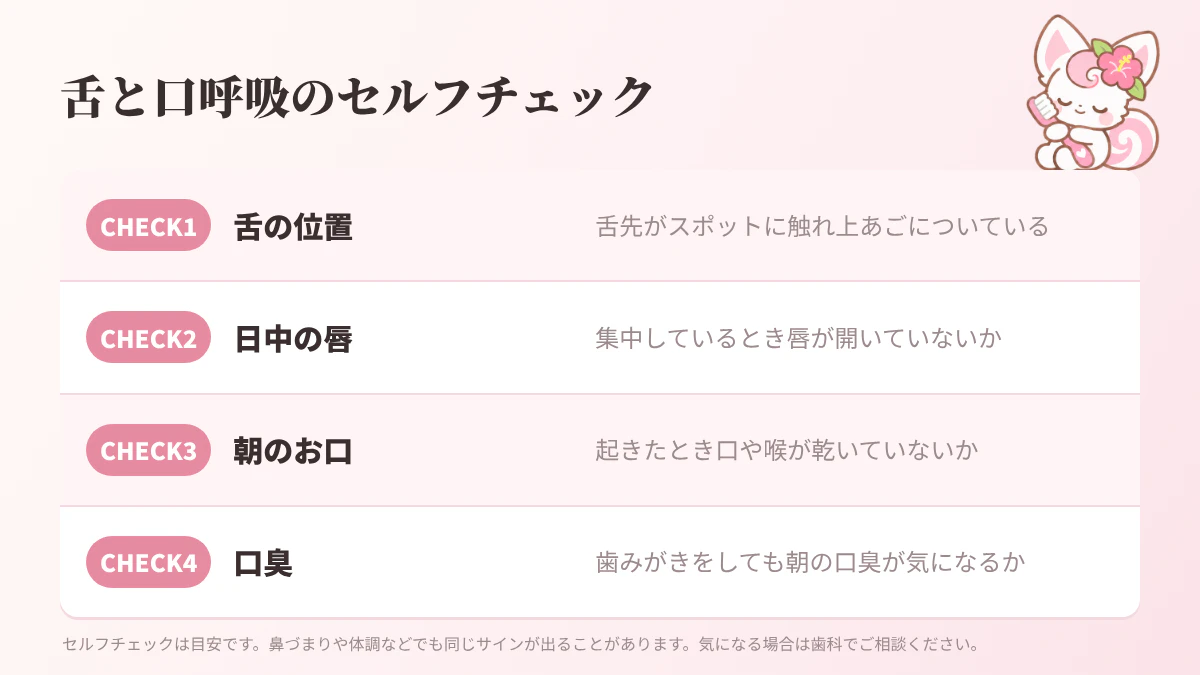
Tooth alignment is said to be maintained by a balance between the force of the tongue from the inside and the force of the lips and cheeks from the outside. If the tongue sits low or the strength to close the lips is weak, this balance is easily lost. Tongue position is often thought of as a "habit," but it is closely related to how you use the muscles around your mouth. We have put the check points in a table.
2. How Mouth Breathing Affects Your Mouth

2-1. A Dry Mouth Can Lead to Cavities and Gum Problems
When you breathe through your mouth, the inside of your mouth dries out easily. Saliva washes away debris and neutralizes the acids that cause cavities, so when dryness continues, the environment changes to one where cavities and gum inflammation occur more easily. The gums around the front teeth in particular are easily affected by dryness, and you may notice swelling or bleeding. Even if you brush your teeth every day, it is important to be aware that dryness can make problems more likely.
2-2. It Can Also Be a Cause of Bad Breath
When there is less saliva, bacteria in the mouth multiply more easily, which can cause bad breath. Bad breath is more noticeable when you wake up because the amount of saliva decreases while you sleep, and if you sleep with your mouth open, the dryness gets even worse. If you are bothered by bad breath even though you brush thoroughly, please take a moment to think about whether you breathe through your mouth during the day or while you sleep.
2-3. It Also Affects the Impression of Your Mouth Area
If your mouth stays open, the muscles that close your lips are used less, and the area around your mouth may look slack. It is also said that an imbalance in the force of the tongue and lips can affect tooth alignment. The impression of your mouth area also affects the impression of your smile. The idea of "growing teeth" that Halulu Shibuya Dental Clinic values includes improving these functions around the mouth.
3. Self-Checks You Can Start Today

3-1. Check Your Mouth During the Day
First, try paying attention to your mouth when you are concentrating on something, such as when you are working on a computer or looking at your smartphone. Check whether your lips are open and whether your tongue is touching the back of your lower teeth. It is also a good idea to ask family or people close to you, "Is my mouth sometimes open?" Simply closing your mouth and placing your tongue back against the roof of your mouth when you notice is a first step toward building awareness.
3-2. Check for Signs When You Wake Up in the Morning
If you notice signs when you wake up, such as a dry mouth or throat, chapped lips, or bad breath, you may be breathing through your mouth while you sleep. However, similar signs can also appear because of a stuffy nose, your physical condition, or dry air in your room. If your nose stays stuffy, it is also important to consult an ENT (ear, nose and throat) clinic or similar. If concerning signs continue, please feel free to consult a dental clinic as well.
4. Self-Care and MFT to Improve Your Tongue and the Area Around Your Mouth
4-1. Practicing the "Spot Position" to Become Aware of Your Tongue Position
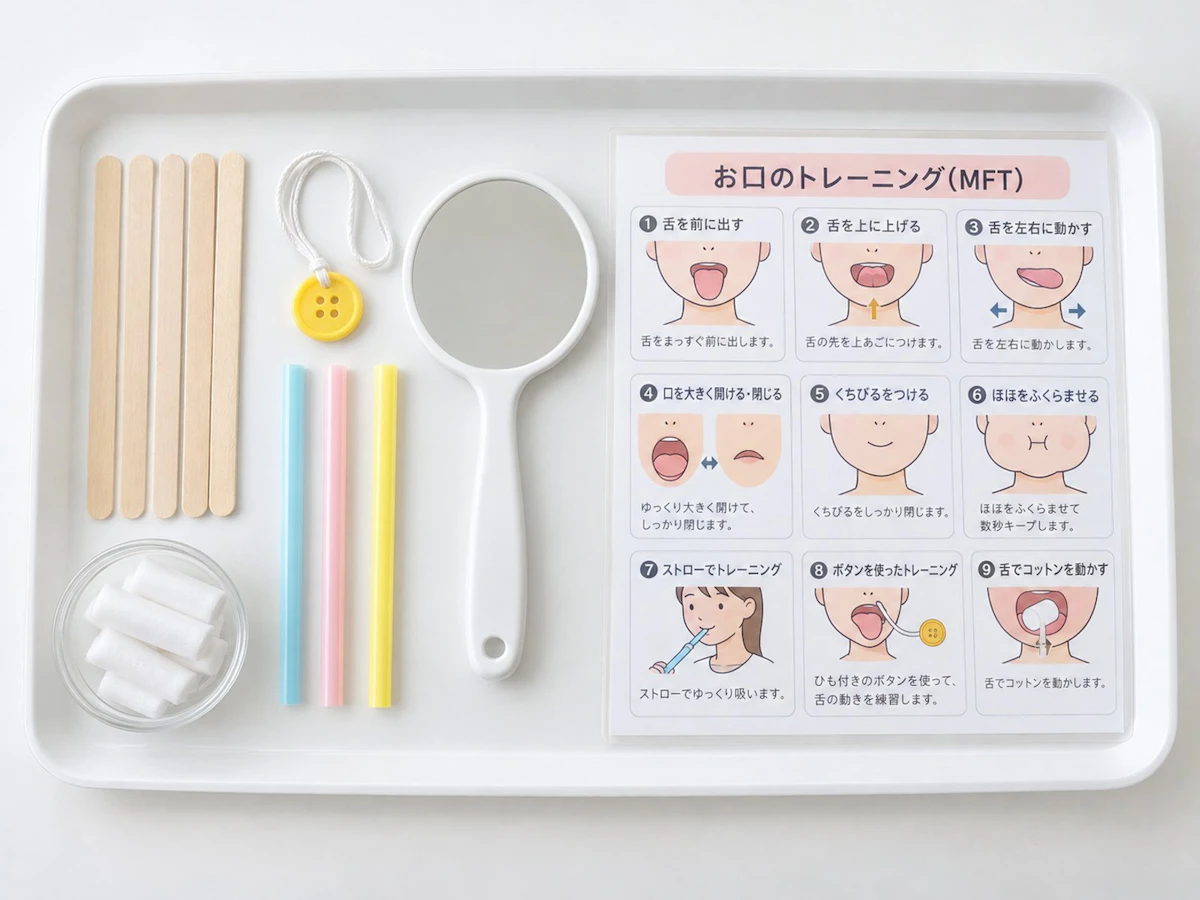
As self-care, there is a practice in which you gently place the tip of your tongue just behind the back of your upper front teeth (the spot) and lift your whole tongue as if suctioning it to the roof of your mouth. Then lightly close your lips, breathe through your nose, and try holding this for several tens of seconds. The key is to not force it, and to repeat it whenever you notice. If you feel pain or discomfort in your tongue or jaw, please stop the practice and consult us.
4-2. What Is MFT (Myofunctional Therapy)?
MFT is training that improves how you use the muscles around your mouth, such as the tongue, lips and cheeks. At our clinic, a dental hygienist checks the condition of your mouth and the movement of your tongue and lips, and teaches you training suited to you. You continue it at home every day, and at your visits we check together whether you are doing it correctly as we move forward. It is suited to people who find it hard to tell whether they are doing self-care correctly, and to people who want to commit to it seriously.
4-3. MFT Cost, Duration and Risks
MFT is self-pay (not covered by Japanese health insurance) and costs ¥3,300 (tax included) per session. First-time patients also pay a separate first-visit counseling fee of ¥3,300 and a first-visit examination fee of ¥2,200 (tax included). The number of visits and the length of time vary depending on the condition of your mouth and your goals, and generally it is something you continue over several months. The training may temporarily cause a feeling of tiredness or discomfort like muscle soreness in the tongue or jaw. Also, how much effect you feel varies from person to person, and you need to continue at home.
For details on MFT, its cost and to consult us, please see the MFT (myofunctional therapy) treatment page.
5. Frequently Asked Questions (Q&A)
5-1. Can I change my tongue position even as an adult?
How you use your tongue and the area around your mouth can be reviewed through awareness and training, even as an adult. However, how much change you feel varies from person to person. Let's start by learning about your current condition.
5-2. Can I tell on my own whether I am a mouth breather?
Signs such as your mouth being open during the day, or your mouth or throat being dry when you wake up, can be a rough guide. However, there are various causes, so if you are concerned, we recommend having your mouth checked at a dental clinic.
5-3. How long should I continue MFT?
It varies depending on the condition of your mouth and your goals. At our clinic, we check how your training is going at each visit, and decide the number of sessions and the length of time together after consulting with you.
Summary
The correct tongue position is "with the tip of the tongue touching the spot and the whole tongue against the roof of the mouth." If mouth breathing continues, your mouth dries out, which can lead to cavities, gum problems and bad breath. First, try starting with the daytime and morning self-checks. At Halulu Shibuya Dental Clinic, our dental hygienists check the condition of your tongue and the area around your mouth, and suggest self-care and MFT. If you are concerned, please feel free to consult us through the reservation form on our clinic website or by phone.
About the author
Rinka Sakamori
Dental hygienist (obtained national qualification in 2017). Representative Director of Ikashika Kyoikukai (General Incorporated Association). Works as a dental hygienist at Halulu Shibuya Dental Clinic.
Our hours are 10:00 to 18:00 on weekdays (Monday to Friday), by appointment only. On weekends, national holidays and in the evening, we see patients by appointment only on days when a doctor is working. Please check the calendar at the time of booking for details.