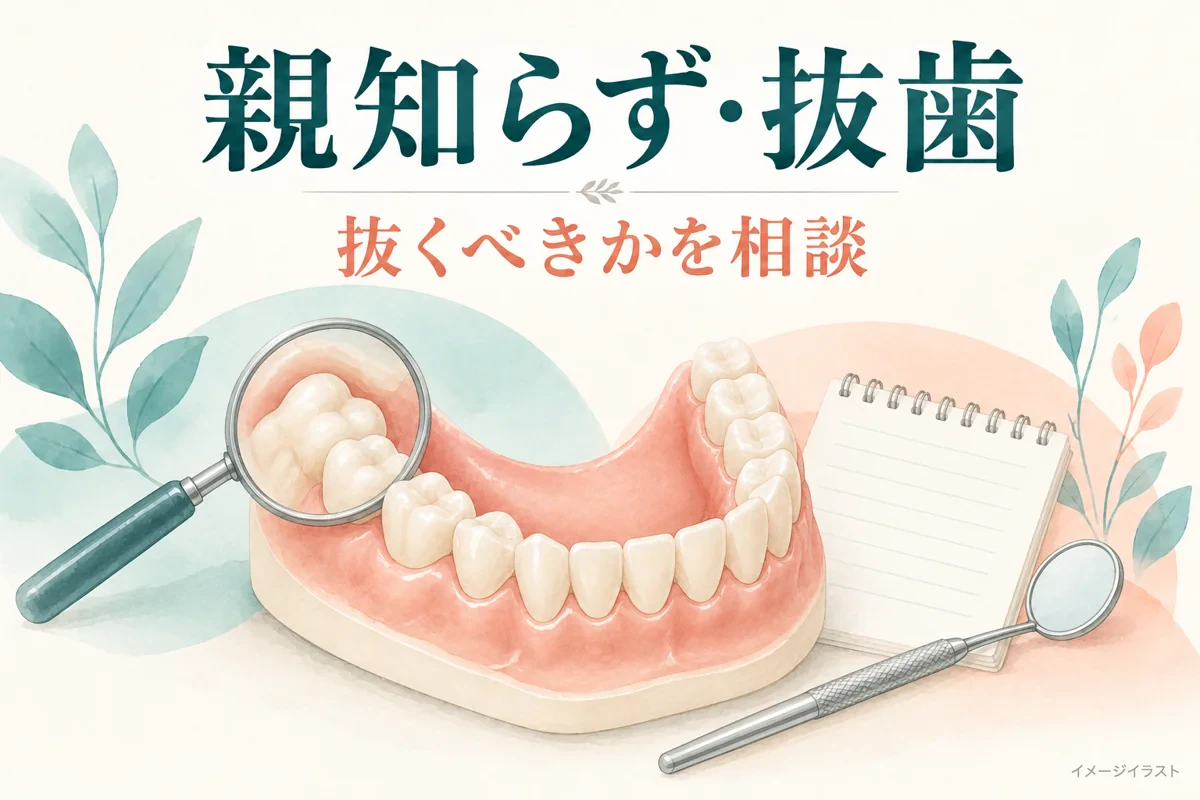
Not every wisdom tooth has to be removed. We consider extraction when the tooth is causing trouble now, or when it is likely to harm the surrounding teeth in the future. The gum around your wisdom tooth is swollen and painful. A dentist has told you, "This tooth will be difficult to keep." At times like this, many questions come up: "Should I really have it pulled?" "Can it be removed right now while it's swollen?" "How much will it hurt afterward?" In this article, Halulu Shibuya Dental Clinic in Jinnan, Shibuya answers these questions in order: when extraction becomes necessary, the extraction process, aftercare and problems that can occur, and how costs work.
Should You Have Your Wisdom Tooth Removed? When to Consider Extraction
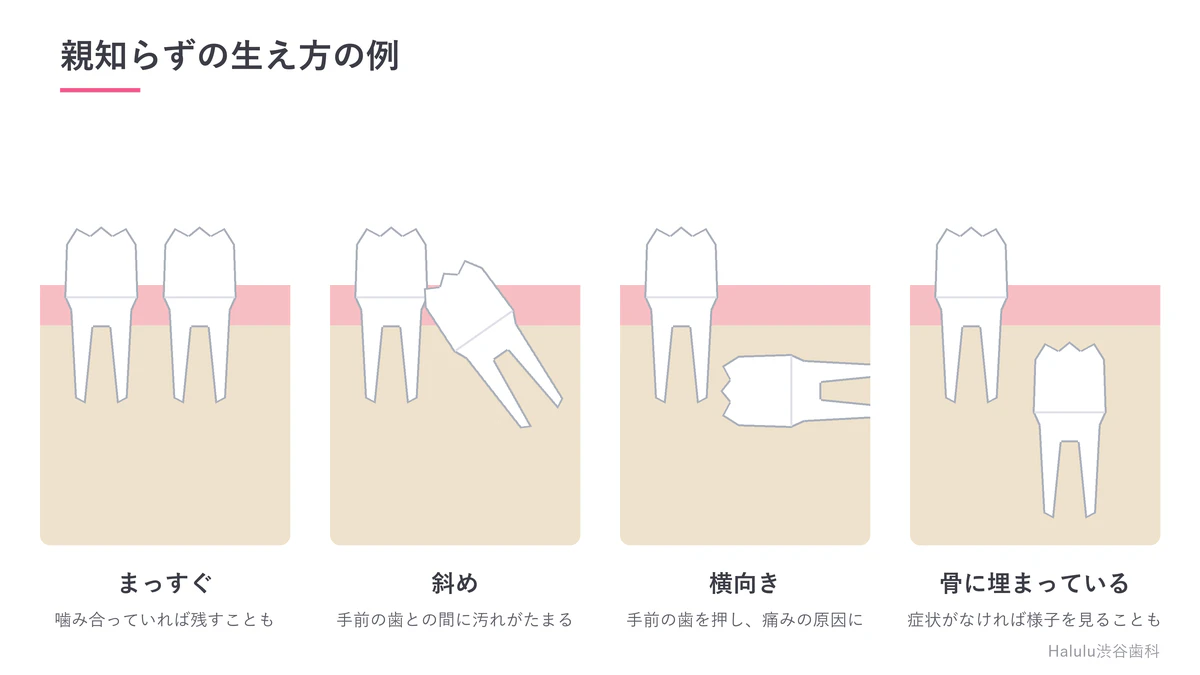
Having a wisdom tooth does not mean it all has to be removed. If it has grown in straight, meets the opposing tooth firmly, and you can brush it properly, it may be left as it is. We consider extraction when the tooth is causing trouble now, or when it is likely to harm the surrounding teeth in the future.
Wisdom teeth
Wisdom teeth are at the very back of the mouth, and they often grow in at an angle or sideways, or only partly emerge from the gum. With this kind of growth, a toothbrush has trouble reaching them, so debris builds up, and the gum tends to swell or to hurt again and again.
We especially encourage you to consult us if you have any of the following.
- The gum around your wisdom tooth swells or hurts repeatedly
- Your wisdom tooth is pushing on the tooth in front of it, causing a cavity in that tooth or concerns about your tooth alignment
- The wisdom tooth itself has a cavity, and it is too far back to treat or brush easily
You cannot tell from appearance alone which way the tooth is growing or how far its roots extend. We check with an X-ray first, and then tell you whether it is better to have the tooth removed. Also, lower wisdom teeth can sit close to the nerve that runs through the jaw. Depending on how the tooth has grown in, it may be better to have it removed at a hospital with an oral surgery department.
Severe cavities and gum disease
For teeth other than wisdom teeth, we also consider extraction if a cavity has progressed deep into the root and no foundation remains, or if gum disease has caused major loss of the bone that supports the tooth and it has become loose. However, if the tooth can still be kept with treatment, we first work with you to find ways to protect it through cavity treatment or gum disease treatment. Our clinic focuses on prevention and values care that keeps your existing teeth as much as possible. If you would like to be sure whether there is a way to keep a tooth before it is pulled, please feel free to consult us.
When It's Swollen and Painful, We First Calm the Inflammation, Then Extract
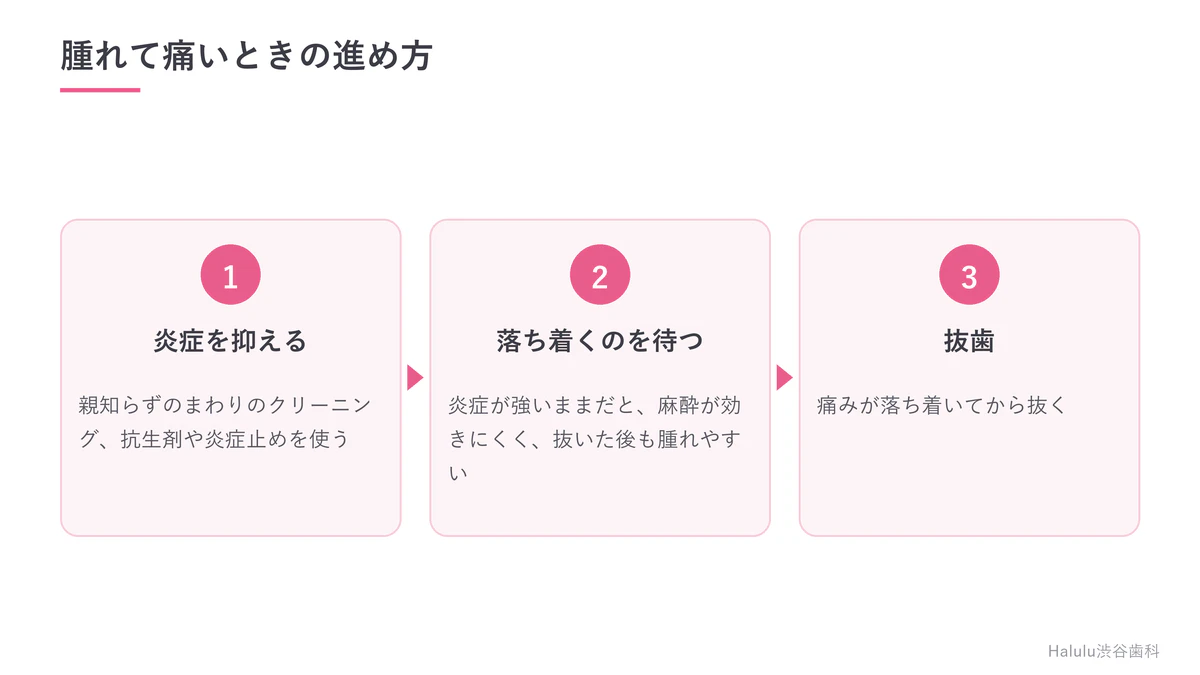
We often hear requests such as, "It's swollen and painful, so please pull it today." However, pain and swelling mean that inflammation has already developed in the gum. If a tooth is extracted while the inflammation is still strong, the anesthetic may not work as well, and swelling and pain are more likely to be strong after the extraction.
For this reason, when there is pain, our clinic recommends first settling the inflammation by cleaning around the wisdom tooth and using antibiotics and anti-inflammatory medication, and extracting afterward. Extracting once the pain has settled makes it easier to keep swelling and pain down afterward as well. For the measures we take from before to after extraction, please see the director's column, How to Reduce Pain and Swelling After Wisdom Tooth Extraction, which explains them in detail.
Recommended For
- People whose wisdom tooth often swells and hurts, or is pressing on a healthy tooth in front of it
- People whose tooth is badly damaged and who have been told it is difficult to keep any longer
- People who are afraid of treatment and want to have a tooth extracted with as little strain as possible
The Extraction Process
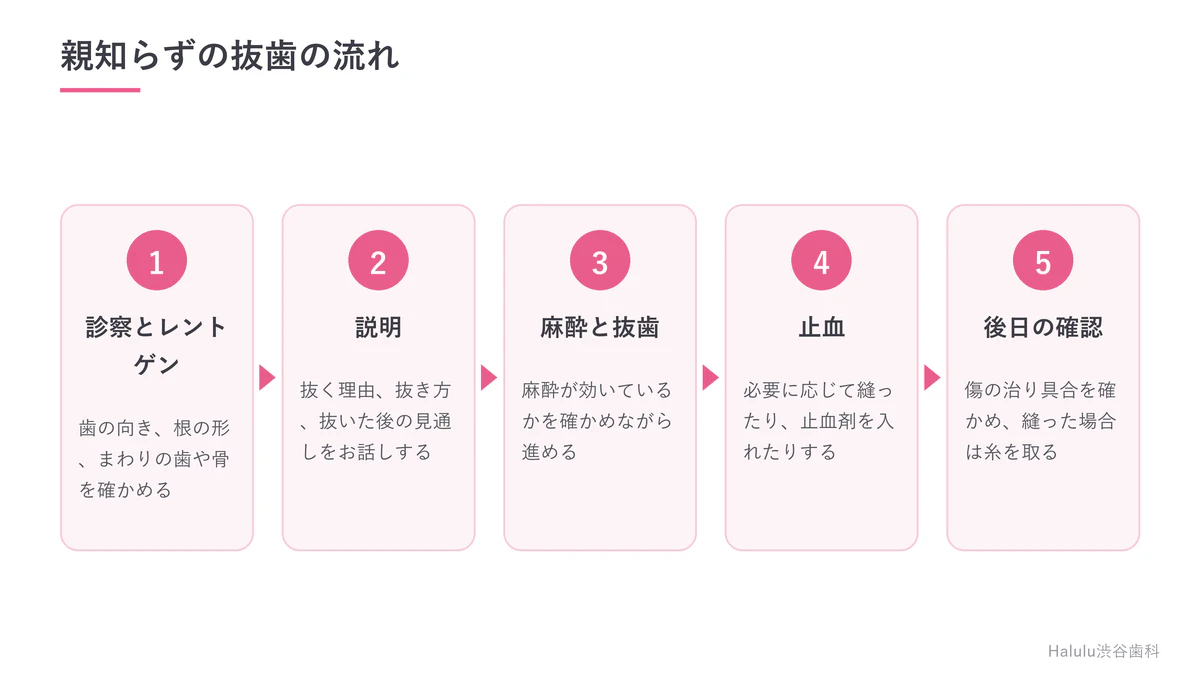
First, we look inside your mouth and take an X-ray to check the direction of the tooth, the shape of its roots, and the condition of the surrounding teeth and bone. Then we explain why extraction is better, how the tooth will be removed, and what to expect afterward, and we proceed once you are comfortable with it. If the swelling or pain is strong, we start with treatment to reduce the inflammation.
On the day of extraction, we begin only after the anesthetic has taken full effect. We proceed while checking that it is working, so if you feel pain at any point, please raise your hand and tell us rather than putting up with it. The longer an extraction takes, the more likely inflammation is to appear afterward. We aim to finish in as short a time as possible, using a procedure that is not forced.
Blood collects in the socket left after a tooth is pulled, and the area heals as that blood clots. We stitch the gum or place a hemostatic agent as needed, to help the blood clot more easily. On a later day, we check how the wound is healing and, if stitches were placed, remove the thread.
Aftercare
After extraction, the most important thing is to rest. Exercise, long baths, saunas, and alcohol increase blood circulation, which can cause bleeding, swelling, and pain. On the day of extraction, please just shower and avoid intense exercise and alcohol.
When the area is swollen, you may want to cool it, but cooling it strongly with ice or cold packs reduces blood circulation and actually slows healing. Please limit yourself to placing a towel dampened with water against your cheek.
The blood clot that forms in the socket works like a lid that protects the wound. Rinsing hard many times, or touching it with your tongue or fingers, can dislodge it. Please rinse gently, and do not touch the extraction site with your toothbrush. Smoking also slows healing, so we ask that you refrain from it.
Risks of Extraction and Problems to Watch For
Because extraction is a procedure that creates a wound in the gum and bone, the following may occur afterward. How they appear varies with how the tooth was growing, how strong the inflammation was before extraction, and how you spend your time afterward.
- Swelling and pain
- Bleeding from the extraction site
- Difficulty opening your mouth, or pain when swallowing
- The blood clot comes off, leaving the bone exposed and causing pain that lasts a long time
- If a lower wisdom tooth is close to the nerve, numbness may appear around the lips and jaw
If the pain keeps getting worse even after taking painkillers, the bleeding does not stop, or the swelling keeps spreading, please contact the clinic without waiting for your next appointment.
What About the Space After Extraction?
In most cases, nothing needs to be placed in the space after a wisdom tooth is pulled. On the other hand, if a tooth that was being used for chewing is extracted and left as it is, the teeth on both sides may tilt in, or the opposing tooth may grow longer, and your bite will gradually break down.
At our clinic, we don't stop at extraction. We propose a plan that includes what to do afterward. One option is a removable denture. Which method suits you depends on where the tooth was extracted, the condition of the surrounding teeth, and your wishes. Talking about this from the consultation stage before extraction makes it easier to see what to expect afterward.
Cost of Wisdom Tooth Extraction
The cost of extraction depends on the condition of the tooth. A tooth that has grown in straight and can be removed as it is, and a difficult extraction in which the gum is cut or the tooth is divided, differ in both the procedure and the cost. Our clinic lists extraction fees on the price list, divided into regular extraction and difficult extraction. A regular extraction is ¥11,000 and a difficult extraction is ¥22,000 (both tax included). Our clinic offers self-pay (not covered by Japanese health insurance) treatment only and does not provide insurance-covered treatment.
We will tell you which applies after checking how the tooth has grown in on the X-ray. Treatment to reduce inflammation or tests may be needed first, so please feel free to ask about anything that concerns you during your examination.
Frequently Asked Questions
Does extraction hurt?
We begin extraction only after the anesthetic has taken full effect. If you feel pain at any point, please let us know right then. Pain may appear after the anesthetic wears off, but taking the painkillers we give you as directed and resting makes it easier to keep under control.
How much will it swell?
Swelling differs from person to person. Swelling is more likely with a wisdom tooth buried sideways, or if the inflammation was strong even before extraction. You may stay swollen for a while after extraction, so it is safer to schedule it so that it does not fall right before an important event.
Can I work or exercise on the day of extraction?
Some people can do work that doesn't involve moving around much, such as desk work, while watching how they feel. However, exercise increases blood circulation and can lead to bleeding and swelling, so please avoid it on the day of extraction. We will tell you when you can resume after seeing the condition of the extraction site.
Consult Us About Wisdom Tooth Extraction in Shibuya
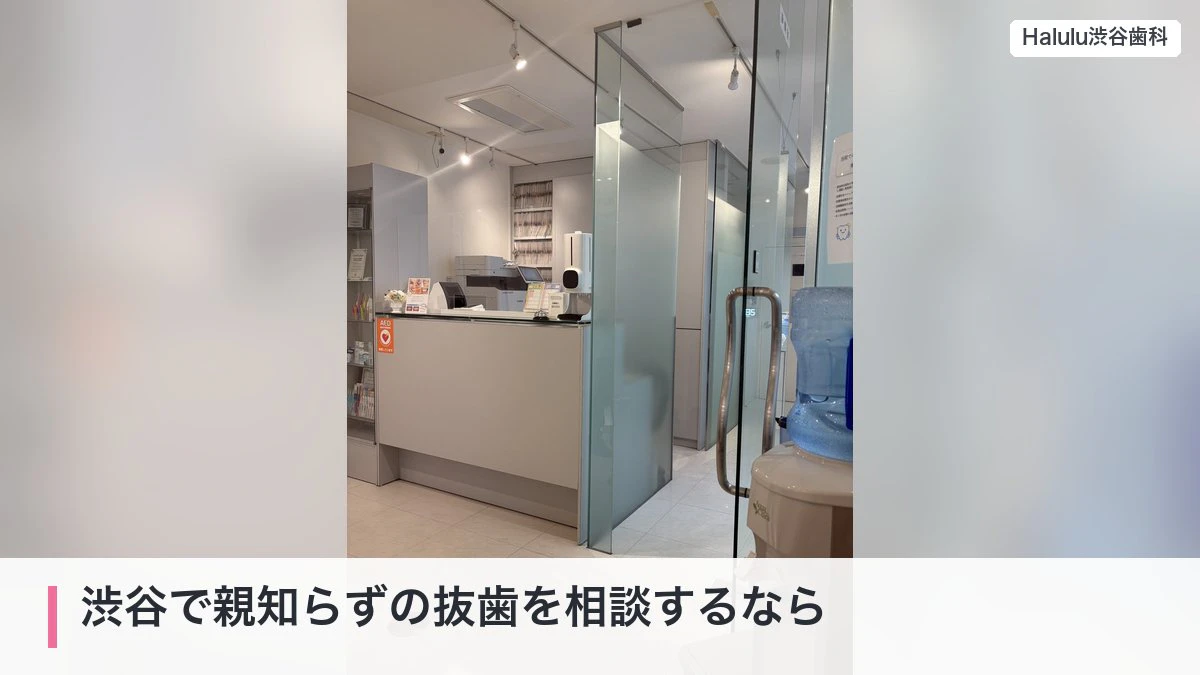
Halulu Shibuya Dental Clinic is on the 4th floor of the Toyama Building in Jinnan, Shibuya-ku, a 5-minute walk from Shibuya Station (JR and other lines). Our director is Kazuya Shiho, a dentist who graduated from Tokyo Medical and Dental University (now Institute of Science Tokyo). We focus on prevention and value care that keeps your existing teeth as much as possible, so you can consult us even at the stage of asking, "Do I really need to have it pulled?"
We explain everything to suit each person's condition: extracting after calming inflammation when the tooth is swollen, aftercare, and what to do about the space after extraction. Wisdom tooth trouble also affects the care of your other teeth, so even after extraction we continue to support your oral health with cleaning and other care.
Our hours are 10:00 to 18:00 on weekdays (Monday to Friday), by appointment only. On weekends, public holidays, and evenings, we see patients by appointment only on days when a doctor is in. Please check the calendar when booking for details. You can book on the web (accepted 24 hours), and we also accept bookings by LINE and by phone (03-5422-3518). If you are worried about a swollen or painful wisdom tooth, please feel free to consult us first.
Book online with Halulu Shibuya Dental Clinic here
This page was reviewed by Dr. Kazuya Shiho, director and dentist at Halulu Shibuya Dental Clinic.