

Most bleeding from the gums when you brush is caused by inflammation of the gums from bacteria, and it can be a sign of gum disease. Injuries from brushing too hard, hormonal changes during pregnancy, medications, and diseases affecting the whole body can also be causes, so there is not always just one reason for bleeding. Even if it doesn't hurt, if the bleeding continues after about 2 weeks of careful brushing, we recommend having an examination at a dental clinic.
It's worrying when you see blood on your toothbrush or in the water when you rinse. But without pain, it's easy to put off a visit. In this article, Halulu Shibuya Dental Clinic in Jinnan, Shibuya, explains the causes of bleeding, what you can check yourself, how to brush when your gums bleed, and when to see a dentist.
Why do gums bleed?
A common cause is a film of bacteria (biofilm) that builds up at the border between the teeth and gums. When bacteria cause inflammation in the gums, they bleed easily even from a light touch of the toothbrush. We explain biofilm in this column. Let's look at each possible cause in turn, including others.
Gum disease (gingivitis and periodontitis)
Gum disease is a condition in which bacteria cause inflammation in the gums and, as it progresses, the bone that supports the teeth dissolves. In the early stages there is almost no pain, so bleeding gums are easily overlooked.
Brushing too hard
Using a hard-bristled toothbrush or brushing with a lot of force can injure the gums and make them bleed. In this case, changing how you brush may help it settle. However, even if you think "I must have brushed too hard," the actual cause may be inflammation.
Hormonal changes during pregnancy
During pregnancy, hormones make the gums more likely to swell and bleed. Morning sickness may also make brushing difficult. For the best time to visit and points to be aware of, see our page on children's and maternity preventive dentistry.
Medications and diseases affecting the whole body
If you take medication that makes your blood less likely to clot, bleeding may be harder to stop. Stopping it on your own judgment can be dangerous, so please talk to the doctor who prescribed it. Gum disease has also been pointed out to be linked to diseases affecting the whole body, such as diabetes. In rare cases, a blood disease can cause bleeding from the gums, so if you have more bruises, nosebleeds that are hard to stop, or lingering fatigue or fever, please see an internal medicine doctor as soon as possible.
What is the difference between gingivitis and periodontitis?
Gum disease is divided into "gingivitis," where the inflammation stays in the gums, and "periodontitis," where it has reached the bone that supports the teeth. Both can cause bleeding when you brush, so bleeding alone cannot tell them apart.
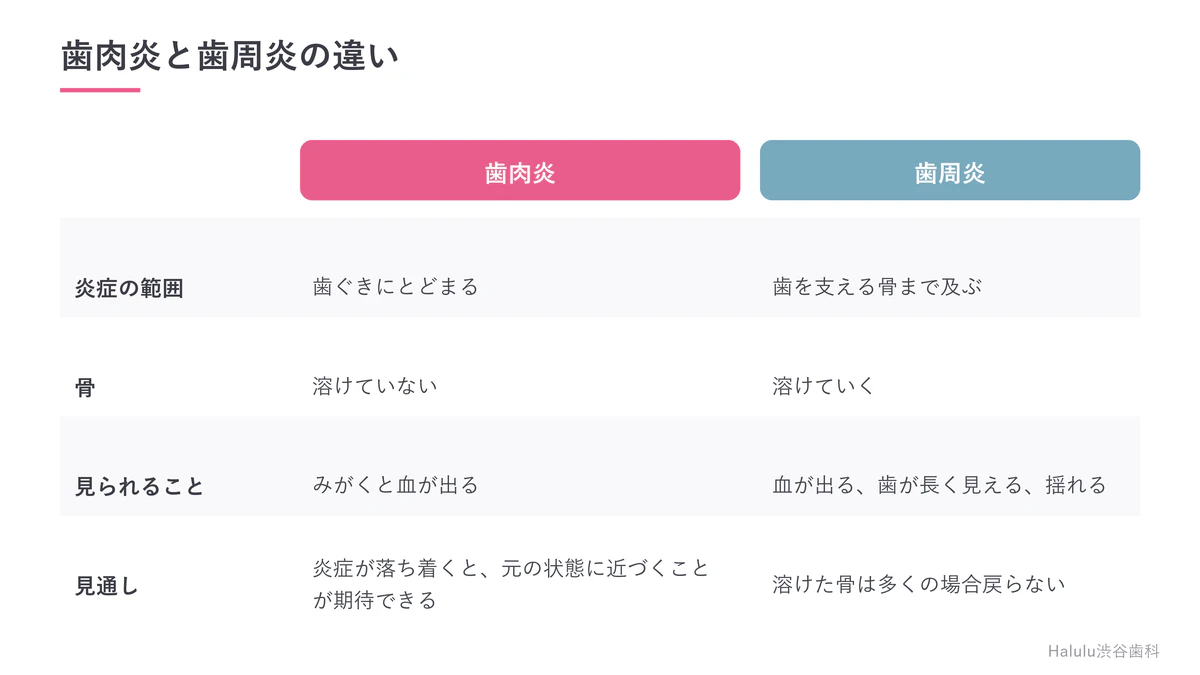
With gingivitis, once the dirt causing it is removed and the inflammation settles, a return to near the original state can be expected. On the other hand, bone that has dissolved due to periodontitis in most cases does not come back. This is why it is important to notice it while it is still gingivitis.
When it progresses to periodontitis, the gums may recede so that the teeth look long, or the teeth may become loose. The groove between the tooth and gum (periodontal pocket) also gets deeper. At our clinic, we judge a groove depth of 4 to 5 mm as mild to moderate, and 6 mm or more as severe gum disease. You cannot measure the depth of the groove yourself, so it is checked with an examination.
Gum disease self-check: do any of these apply to you?
Please check the following items. If even one applies to you, we recommend having an examination once.
- Your gums bleed when you brush your teeth
- Your gums are red and swollen, or itchy
- Your gums have receded and your teeth look longer
- You are worried about bad breath, or someone has pointed it out
- Your teeth feel like they are floating, they feel loose, or it is hard to bite hard foods
With gum disease, it is not uncommon for it to have progressed to some extent by the time you notice symptoms. This check is meant as a prompt to see a dentist, and even if none of these apply, we cannot say you do not have gum disease. If you smoke, please also be aware that signs such as bleeding can be harder to notice.
Should I avoid brushing when my gums bleed?
Please do not avoid it; keep brushing gently. If the bleeding is caused by inflammation, stopping brushing lets even more dirt build up.
- Do not use too much force: Use a softer toothbrush and brush with small movements along the border between the teeth and gums.
- Clean between your teeth too: A toothbrush alone has trouble reaching there, so please use interdental brushes or dental floss every day. You may bleed a little when you first start using them.
- Talk to us about smoking: Smoking reduces blood flow to the gums and makes gum disease more likely to progress. If you smoke, please talk to us.
Mouthwash does not remove tartar deep in the periodontal pockets. Hardened tartar cannot be removed by brushing, so it is removed at a dental clinic. If you have strong pain or swelling, do not force yourself to brush; please contact us early.
When should I see a dentist?
So when is a good time to consult a dentist? In cases like the following, we recommend a visit.
- The bleeding continues for about 2 weeks even though you brush carefully
- Blood seeps out even when you are not doing anything
- Your gums are swollen, painful, or discharging pus
- Your teeth feel loose, or something feels wrong when you bite
- You have not had a dental examination for a while
If the bleeding does not stop even when you press on it with clean gauze or similar, or if there is strong pain, swelling, or fever along with the bleeding, please contact a medical institution without waiting to see how it goes.
What does a dentist check, and how is it treated?
Our gum treatment focuses on removing the tartar and biofilm that cause the problem. The flow is as follows.
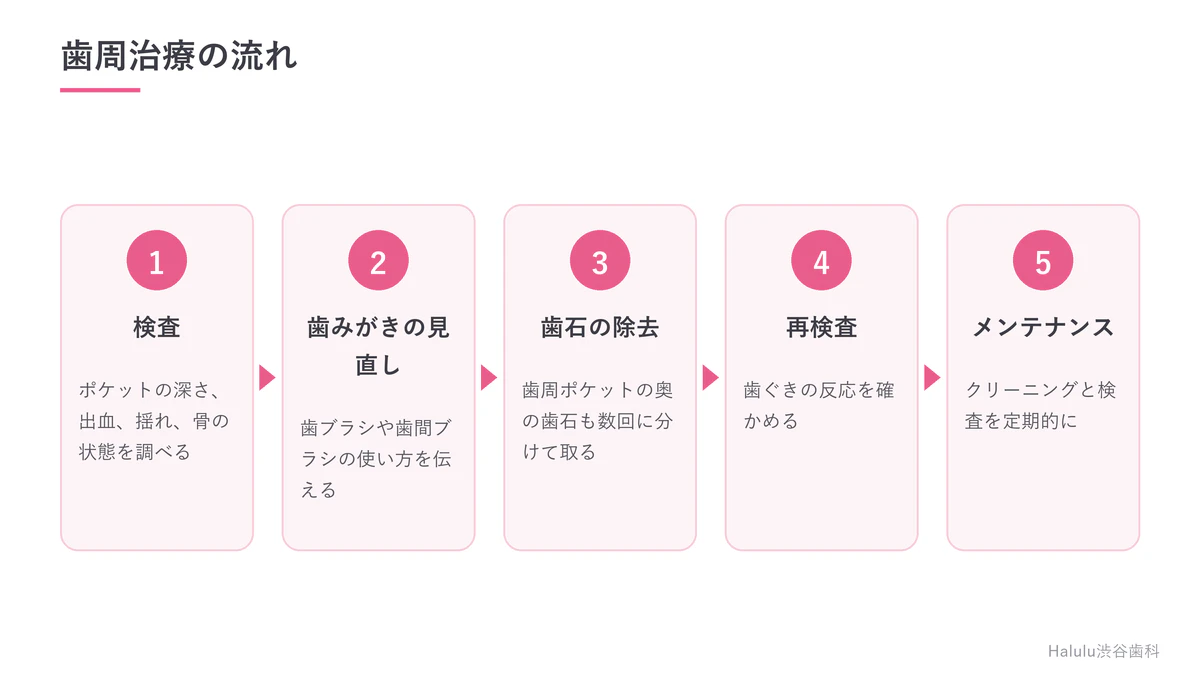
- Examination: We check the depth of the periodontal pockets, bleeding, tooth looseness, and the condition of the bone on X-rays.
- Review of brushing: We explain how to use your toothbrush and interdental brushes to suit the condition of your mouth.
- Removal of tartar and biofilm: We remove not only the tartar above the gums but also the tartar deep in the periodontal pockets, over several visits.
- Re-examination: We check how your gums have responded and identify areas where improvement is lacking. If deep pockets remain, we consider surgical treatment or laser treatment.
- Maintenance: To keep your mouth in good condition, we continue regular cleaning and examinations.
Gum treatment is not something that finishes in one visit; we aim for improvement over several visits even for mild cases, and over several months when it has progressed. The details of treatment are summarized on our gum treatment page. We also offer cleaning to remove dirt from the tooth surface, but if tartar has gone under the gums, we will guide you to gum treatment after an examination. For those who want a detailed check including CT and a saliva test, there is the Oral Dock (comprehensive dental check-up).
Costs, and what we would like you to know
Our clinic offers self-pay (not covered by Japanese health insurance) treatment only, and does not provide insurance-covered treatment. At dental clinics that provide insurance-covered treatment, gum disease treatment can be received with insurance. Our fees are as follows (all tax included).
- Initial consultation fee: ¥5,500 (includes counseling and a basic examination)
- Gum treatment: from ¥330,000 (varies depending on how far the disease has progressed)
- Regular cleaning (30 minutes): ¥5,500
- Intensive cleaning (60 minutes): ¥11,000
- Oral Dock (comprehensive dental check-up): ¥38,500
We explain the cost in advance, after the examination. The interval between cleanings is generally about every 3 months to 6 months, and we will suggest one to suit the condition of your mouth. Self-pay treatment may be eligible for the medical expense deduction. Please check the latest fees on our price list.
Before you receive treatment, please also be aware of the following points.
- When the swelling of the gums goes down, the gums may recede so that the teeth look longer, or gaps may appear between the teeth.
- After tartar is removed, your teeth may feel sensitive for a while.
- If your gums are inflamed, they may bleed a little or feel sensitive during cleaning.
- Bone that has dissolved in most cases does not come back. Treatment mainly focuses on stopping progression and maintaining the current condition.
- Even after treatment, if you do not continue daily care and regular maintenance, the disease may come back.
- With the X-rays and CT in the Oral Dock (comprehensive dental check-up), you are exposed to a small amount of radiation. If you are pregnant or may be pregnant, please let us know beforehand.
Frequently asked questions
My gums bleed but don't hurt. Should I see a dentist?
Gum disease causes almost no pain in the early stages, so the absence of pain alone is not a reason to feel reassured. If the bleeding continues for about 2 weeks even though you brush carefully, we recommend having a gum disease examination.
Should I avoid brushing the places that bleed?
If the bleeding is caused by inflammation, stopping brushing lets dirt build up and the inflammation is more likely to continue. Please brush with a softer toothbrush, without using too much force. If you have strong pain or swelling, don't push yourself; please consult a dentist.
If tartar is removed, will the gum bleeding stop?
If the cause of the bleeding is inflammation from tartar or biofilm, removing them can be expected to help it settle. However, the time it takes to settle varies from person to person, and you also need to continue your daily care.
My gums bleed during pregnancy. May I see a dentist?
During pregnancy, hormones make the gums more likely to swell and bleed. The second trimester (around weeks 16 to 27) is said to be the easiest time to visit, but if bleeding or swelling continues and you are worried, please consult us regardless of the timing. When you visit, please bring your Maternal and Child Health Handbook (boshi techo) and tell us how many weeks pregnant you are and how you are feeling.
I taste blood when I wake up in the morning. Is it gum disease?
It is possible that your gums bleed while you sleep, but the bleeding may also come from the nose or throat, so the cause cannot be determined from the symptom alone. If it continues, we recommend having an examination at a dental clinic.
If you want to consult about bleeding gums in Shibuya
Halulu Shibuya Dental Clinic is on the 4th floor of the Toyama Building in Jinnan, Shibuya-ku, a 5-minute walk from Shibuya Station (JR and other lines). Our director, Dr. Kazuya Shiho, is a dentist who graduated from Tokyo Medical and Dental University (now Institute of Science Tokyo), and he values care that centers on prevention and protects your existing teeth as much as possible. If you are concerned about bleeding gums, please consult us early.
Our hours are 10:00 to 18:00 on weekdays (Monday to Friday), by appointment only. On weekends, public holidays, and evenings, we see patients by appointment only on days when a doctor is in. You can make a reservation on the web (accepted 24 hours), as well as by LINE or phone (03-5422-3518). If it is your first visit, we will first hear about your concerns at the initial counseling (initial consultation fee ¥5,500).
Book online at Halulu Shibuya Dental Clinic here
This article was supervised by Dr. Kazuya Shiho, Director and dentist at Halulu Shibuya Dental Clinic.