
Even if you have been told your tooth's nerve needs to be removed, vital pulp therapy may be able to save it, depending on how inflamed the nerve is. Vital pulp therapy is a treatment that removes deep decay that has reached close to the nerve (the dental pulp), covers the nerve with a protective medicine, and aims to keep the nerve rather than remove it. However, if the inflammation of the nerve is advanced, for example when the tooth hurts strongly even when you are doing nothing, the nerve may not be savable.
When you hear "we should remove the nerve," you naturally wonder whether that really is the only option. In this article, Halulu Shibuya Dental Clinic in Jinnan, Shibuya explains why keeping the nerve matters, how to tell which teeth can and cannot be saved, the treatment steps, and the cost and risks. You can also find details of the treatment on our vital pulp therapy page.
What does the nerve of a tooth (the dental pulp) do?
Inside each tooth is a part called the dental pulp. It is what is commonly called the "nerve," but in fact it contains blood vessels as well as nerves. The pulp delivers nourishment to the tooth and senses stimuli such as cold and heat.
Sensitivity and pain are unpleasant. Even so, it is because of these sensations that you can more easily notice something is wrong when a cavity forms, or when decay comes back under a filling.
What happens to a tooth when the nerve is removed?
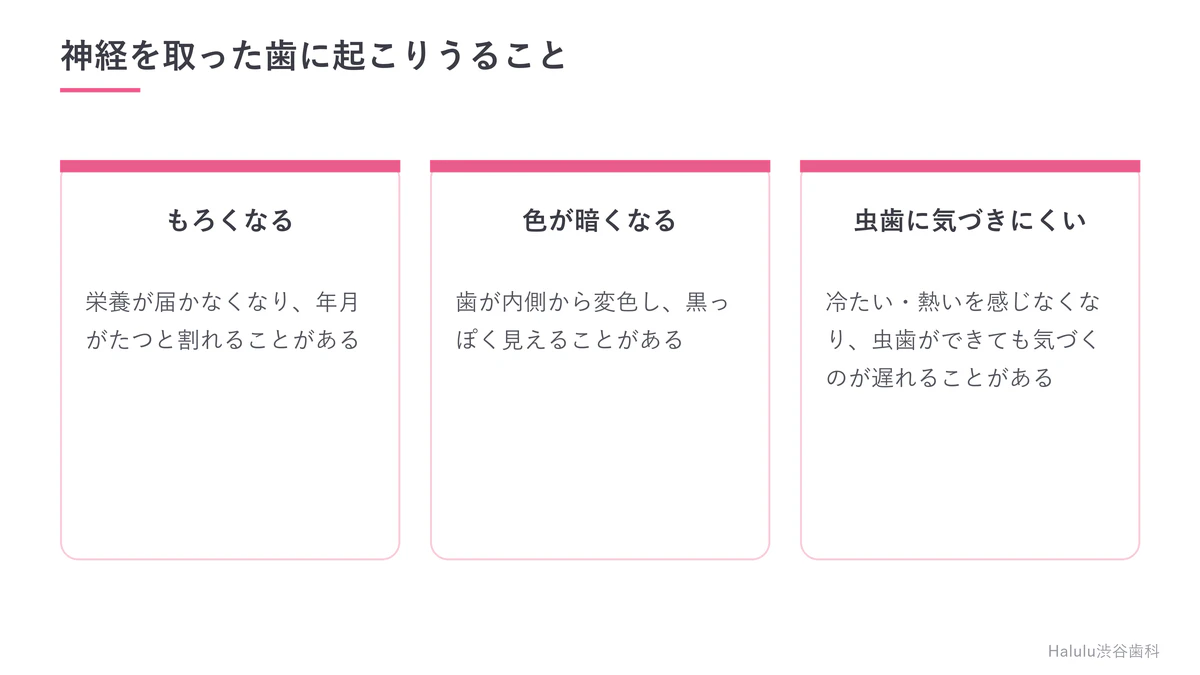
A tooth whose nerve has been removed often has less tooth structure left because of decay and previous treatment, and it may become more likely to break. Over the years, it may also darken in color. When just one front tooth looks blackish, it can be because a tooth whose nerve was removed is discoloring from the inside. We have summarized this in our column Why only one front tooth is dark, and how to whiten it.
Also, once the nerve is removed, you no longer feel cold or heat in that tooth, so you may be slower to notice if decay forms in it again. Removing the nerve is a necessary treatment to keep the tooth. Even so, when there is a possibility that the nerve can be saved, we first consider vital pulp therapy.
Can a tooth that was said to need nerve removal still be saved?
Sometimes it can. Whether the nerve needs to be removed depends not only on how deep the decay is, but also on how far the inflammation of the nerve has spread. Even if the decay has reached close to the nerve, if the inflammation is limited to one part, the nerve may be saved by removing the damaged part and protecting the rest of the nerve.
On the other hand, if the inflammation has spread throughout the nerve, saving it becomes difficult. If it is left as it is, strong pain may appear later, or pus may collect at the tip of the root. In that case, root canal treatment is needed.
Even when teeth are described in the same way as having "deep decay," whether the nerve can be saved differs from tooth to tooth. Even for a tooth that another dental clinic said needed nerve removal, we can check your symptoms and X-rays and tell you whether there is a possibility of saving it.
How do you tell which teeth can and cannot be saved?
One clue is the way the tooth hurts. We consider vital pulp therapy in cases like the following.
- The decay is deep, but there is no throbbing pain when you are doing nothing
- The tooth is sensitive to cold, but the sensitivity goes away right away
On the other hand, in cases like the following, the inflammation of the nerve is often advanced, and the nerve may not be savable.
- It hurts strongly even when you are doing nothing
- It hurts so much that you cannot sleep at night
So what if the pain suddenly disappears? If the pain subsides after strong pain, the nerve may have died. Even if the pain is gone, the decay has not healed, so please contact us early.
The way the pain feels is only a guide. In the end, we check the depth of the decay and its distance from the nerve on an X-ray, and make a decision by looking at the condition of the nerve during treatment. To give yourself the best chance of keeping the nerve, we recommend having the tooth examined while it is still only sensitive.
What is done in vital pulp therapy?
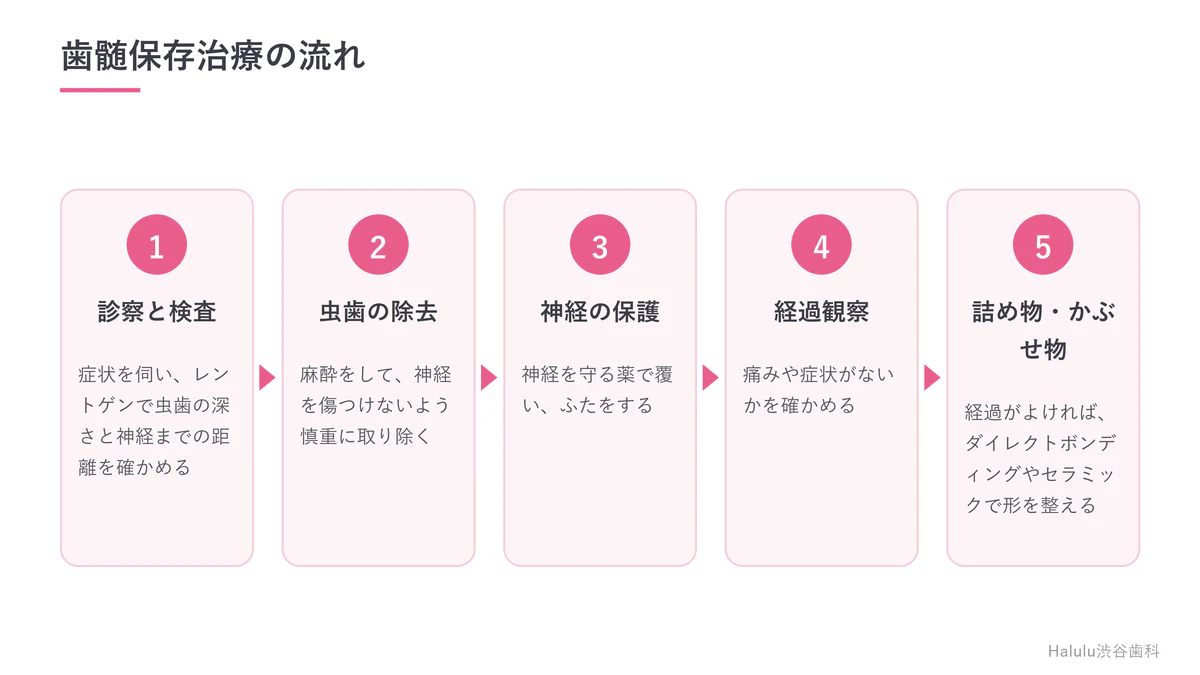
At our clinic, we proceed as follows.
- Examination and tests: We listen to your symptoms and check the depth of the decay and its distance from the nerve on an X-ray.
- Removal of the decay: Under anesthesia, we carefully remove the decay so as not to damage the nerve.
- Protection of the nerve: We cover the nerve with a medicine that protects it and seal it.
- Follow-up observation: We watch the tooth for a while and check whether there is any pain or other symptoms.
- Final filling or crown: If progress is good, we restore the shape with direct bonding or ceramic.
During treatment, it may turn out that saving the nerve is difficult. In that case, we explain the condition on the spot and discuss the treatment plan with you. The time treatment takes differs depending on the size of the decay, so at your examination we will tell you what to expect, including the follow-up observation period.
What should I watch for after treatment?
After treatment, the tooth may be sensitive for a while, or feel uncomfortable when you bite. In many cases this settles as days go by, but if the sensitivity becomes stronger or changes into throbbing pain, please contact us early. This is because, if the inflammation of the nerve was more advanced than expected, treatment to remove the nerve may be needed later.
During the follow-up observation, please visit at the times we instruct so that we can check for pain or other symptoms. Even after the final filling or crown is placed, we will keep checking through regular cleanings and check-ups whether decay has come back around the filling.
Cost, and risks you should know about
Vital pulp therapy is self-pay (not covered by Japanese health insurance). Our clinic offers self-pay treatment only and does not provide insurance-covered treatment. The fees are as follows (all tax included).
- Vital pulp therapy: ¥44,000
- First visit fee: ¥5,500 (includes counseling and basic examinations)
The cost of the final filling or crown is charged separately, depending on the material you choose. According to our price list, direct bonding is ¥22,000, ceramic fillings start from ¥55,000, and crowns start from ¥88,000 (per tooth). Before starting treatment, we will tell you the expected total. Self-pay treatment may be eligible for the medical expense deduction. Please check the latest fees on our price list.
Please also check the following points before you undergo treatment.
- If the inflammation of the nerve was more advanced than expected, pain may appear after treatment, and treatment to remove the nerve may be needed.
- After treatment, the tooth may be sensitive for a while, or feel uncomfortable when you bite.
- During treatment, it may turn out that saving the nerve is difficult.
Frequently asked questions
Can a tooth that was said to need nerve removal always be saved?
It cannot always be saved. If the inflammation of the nerve is limited to one part, there is a possibility it can be saved, but if the inflammation has spread, root canal treatment will be needed. We will explain the likelihood of saving it after an examination.
Another dental clinic said they would remove my nerve. Can I consult you?
Yes, you can. We will listen to your symptoms, check the depth of the decay and its distance from the nerve on an X-ray, and tell you whether there is a possibility of saving the nerve.
The throbbing pain has gone away. Is it okay now?
If the pain subsides after strong pain, the nerve may have died. The decay has not healed, and if it is left as it is, pus may collect at the tip of the root, so please visit us early.
Does it hurt during treatment?
We perform treatment after giving anesthesia. If you feel pain during treatment, please let us know right away.
How much does vital pulp therapy cost?
Vital pulp therapy is ¥44,000 (tax included). In addition, the first visit fee of ¥5,500 and the cost of the final filling or crown, depending on the material you choose, are charged.
Consulting about a tooth you were told needs nerve removal in Shibuya
Halulu Shibuya Dental Clinic is on the 4th floor of the Toyama Building in Jinnan, Shibuya-ku, a 5-minute walk from Shibuya Station (JR and other lines). Our director, Dr. Kazuya Shiho, is a dentist who graduated from Tokyo Medical and Dental University (now Institute of Science Tokyo), and he values care that centers on prevention and protects the teeth you have now as much as possible. What we emphasize for that purpose is the approach of removing as little tooth as possible and keeping the nerve as much as possible.
Our hours are 10:00 to 18:00 on weekdays (Monday to Friday), by appointment only. On weekends, public holidays and evenings, we see patients by appointment only on days when a doctor is in. You can book on the web (accepted 24 hours), and also by LINE or phone (03-5422-3518). If it is your first visit, we will first listen to your concerns at the first-visit counseling (first visit fee ¥5,500). You can also see the overall flow of cavity treatment on our cavity treatment page.
Book online at Halulu Shibuya Dental Clinic here
This article was reviewed by Dr. Kazuya Shiho, Director and dentist at Halulu Shibuya Dental Clinic.