

Depending on the size of the gap and the alignment of your teeth, small gaps or chips in the front teeth can sometimes be fixed in 1 day with direct bonding. Direct bonding is a treatment in which dental plastic (composite resin) close to the color of your teeth is applied directly to the tooth, hardened with light, and shaped. Because no impressions are taken, it is basically finished on the same day. However, if the gap is large, or if the cause lies in your tooth alignment or bite, orthodontics or ceramics may be a better fit.
When you talk with people or have your picture taken, it is hard not to notice a gap or chip in your front teeth, isn't it? In this article, Halulu Shibuya Dental Clinic in Jinnan, Shibuya explains what direct bonding can fix and when it is not suitable, the flow of the 1-day treatment, how long it lasts, and the cost and risks. You can also find details of the treatment on our direct bonding page.
What is done in direct bonding?
After preparing the surface of the tooth, paste-like dental plastic is applied little by little. It is hardened with light, shaped, and finally polished to a shine. Because the dentist shapes it directly in your mouth, there are no impressions like those for ceramics made in a dental laboratory, and no waiting period for the finished piece.
The material comes in a variety of colors, and we choose and use a color that matches the surrounding teeth. Because no metal is used, it is also a treatment that is easy to choose for people who are worried about metal allergies.
Can a gap in the front teeth be filled with direct bonding?
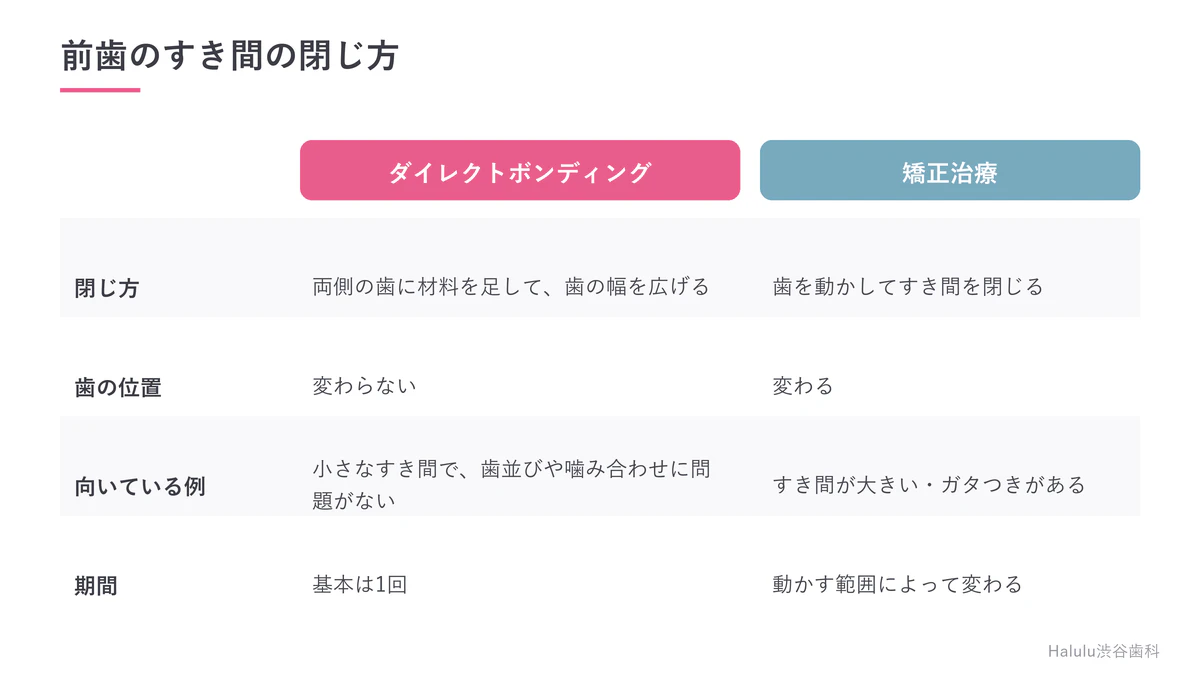
Depending on the size of the gap, it can be filled. The material is added little by little to the teeth on both sides of the gap, widening the teeth to close it. A gap in the middle of the front teeth (diastema) can also be closed this way, depending on its size.
On the other hand, you need to be careful when the gap is large. Because the teeth become wider by the amount filled in, their shape may look unnatural compared with the other teeth. In that case, orthodontic treatment, which moves the teeth to close the gap, may give a better-looking result.
We also check why the gap formed
A gap in the front teeth can be caused by the original size or the way the teeth came in. It can also form when gum disease reduces the bone that supports the teeth and the teeth move. A habit of pushing the front teeth with the tongue may also be involved. If the gap is filled while the cause remains, another gap may form somewhere else later. For this reason, we check the condition of your gums and your bite before filling it. If there is inflammation in the gums, our approach is to carry out gum disease treatment first. If tooth alignment is the cause, we will explain it at an orthodontic consultation (¥0), comparing it with closing the gap by orthodontics.
Can chipped front teeth or small cavities also be fixed?
If the tip of a front tooth is slightly chipped, or a corner is broken and the shape bothers you, direct bonding can sometimes restore the shape as long as the chip is small. Material is added to the chipped area and the shape is matched to the neighboring tooth.
For a small cavity, the decayed part is removed and the hole is filled with dental plastic. Often only the decayed part needs to be removed, and a feature is that as much healthy tooth as possible can be kept. It can also be used to redo a filling when plastic placed previously has become discolored and noticeable.
So what if the chip is large? If a part that takes biting force is largely chipped, plastic may break easily. In that case, we may suggest a ceramic crown or filling.
When is direct bonding not suitable?
In cases like the following, another method may be a better fit.
- The gap is large, and filling it would make the tooth unnaturally wide
- You want to correct the alignment of the teeth themselves, such as crowding or twisting of the front teeth
- The cavity is large, or the chipped area is large
- The spot is one that takes strong biting force
- You grind your teeth or clench strongly
Which method suits you cannot be decided just by looking in a mirror. After checking your teeth and bite at the examination, we will explain the advantages and burdens of each, so please compare them before choosing. We have summarized how to think about making silver teeth white in our column on when to replace silver teeth with ceramics.
How much is finished in 1 day? The treatment flow
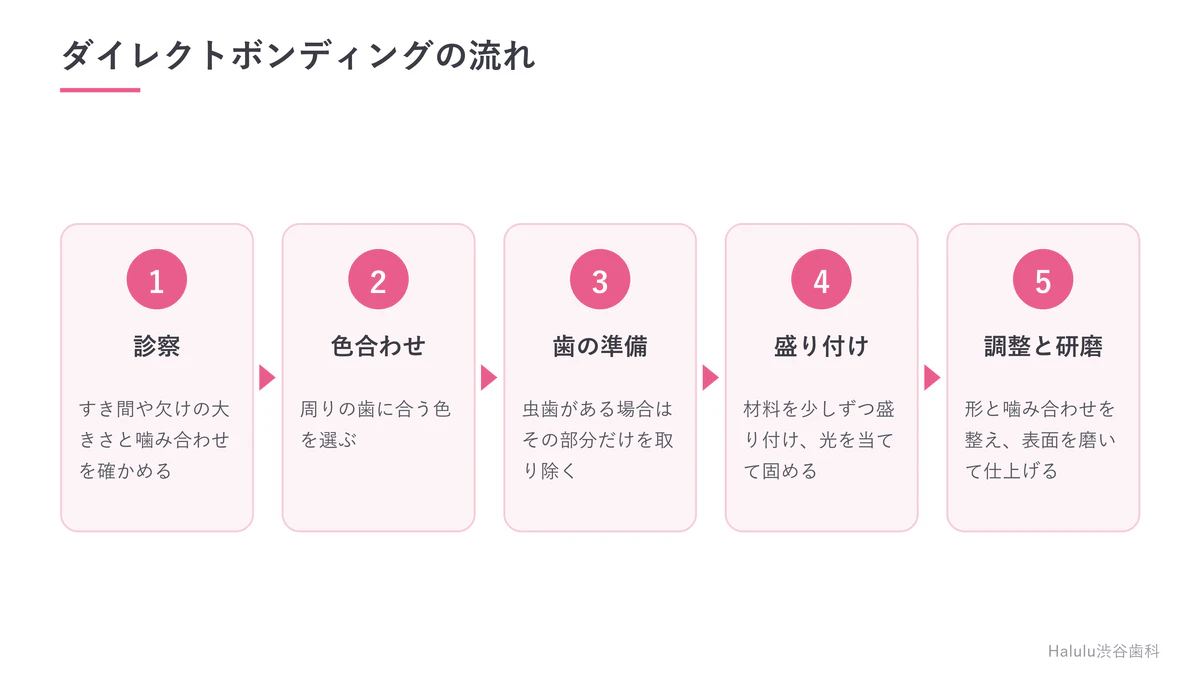
At our clinic, we proceed as follows.
- Examination: We check the size of the gap or chip, whether there are cavities, and your bite, and judge whether direct bonding suits you.
- Color matching: We choose a color that matches the surrounding teeth.
- Tooth preparation: If there is a cavity, only that part is removed.
- Application and hardening: Dental plastic is applied little by little and hardened with light.
- Adjustment of shape and bite, and polishing: We shape the tooth, check your bite, and finish by polishing the surface.
Because no impressions are needed, it is basically finished in 1 visit. However, if many teeth are being treated, or if a large shape is being built up, it may be divided into several visits.
How long does direct bonding last?
What affects how long it lasts is your bite and how well you care for it. Dental plastic wears down more easily than natural teeth or ceramics, and its color may change over time.
On the other hand, for small chips or discoloration, in many cases it can be repaired by adding material in part or polishing again, without redoing it by drilling. The following points help it last longer.
- After having strongly colored things such as coffee, black tea, red wine or curry, rinse your mouth or brush your teeth
- Do not bite through hard things with your front teeth, and do not bite your nails
- If you grind your teeth or clench, protect your teeth with a mouthguard when you sleep
- Have the surface polished again at regular cleanings
If you are also considering whitening, which comes first?
We recommend doing the whitening first. The material used in direct bonding does not change color even if you whiten your teeth. If you fill first and then whiten your teeth, only the filled area may look darker than the surrounding teeth.
If you would like your teeth to be brighter, whiten them first with something like office whitening, and then fill to match that shade. Please talk with us about the order to proceed in at your first-visit counseling.
Cost, and risks we would like you to know about
Direct bonding is self-pay (not covered by Japanese health insurance). Our clinic offers self-pay treatment only and does not provide insurance-covered treatment. The costs are as follows (all tax included).
- Direct bonding: ¥22,000
- First-visit fee: ¥5,500 (includes counseling and basic examination)
The total cost changes depending on the number of teeth and the extent treated, so we will tell you after the examination, before starting. Self-pay treatment may be eligible for the medical expense deduction. Please check the price list for the latest fees.
Please also check the following points before treatment.
- Over time, it may become discolored or worn down.
- If strong force is applied, it may chip or come off. In that case, repair or redoing is needed.
- Cavities may come back at the border between the filling and the tooth.
- After drilling, the tooth may be sensitive for a while.
- Because the position of the teeth does not change, the alignment of the teeth itself is not corrected.
Frequently asked questions
Can a gap in the front teeth really be filled in 1 day?
If the gap is small and there are no problems with your gums or bite, it is basically finished on the same day. If there are multiple gaps, or if a large shape is being built up, it may be divided into several visits.
Do you drill the tooth in direct bonding?
If there is a cavity, only that part is drilled. When filling a gap or adding to a chip, how much the tooth surface is prepared depends on the condition of the tooth, so we will explain it at the examination.
Which is better, direct bonding or ceramics?
For small gaps or chips, when you want to finish in 1 visit, direct bonding is an option. If the chip is large, or if you place importance on resistance to color change, ceramics may be a better fit. You can also see the differences in the comparison table on our direct bonding page.
What happens if it chips or changes color later?
For small chips or discoloration, in many cases it can be repaired in part without redoing it by drilling. At regular cleanings, we also check the condition of the filled area.
How should I choose between orthodontics and direct bonding?
If the gap is small and there are no problems with your tooth alignment or bite, filling it with direct bonding is suitable. If the gap is large, or if you also want to correct crowding, orthodontics may be a better fit. If you are unsure, at an orthodontic consultation we will compare both methods and explain them to you.
If you want to consult about gaps or chips in your front teeth in Shibuya
Halulu Shibuya Dental Clinic is on the 4th floor of the Toyama Building in Jinnan, Shibuya-ku, a 5-minute walk from Shibuya Station (JR and other lines). Our director, Dr. Kazuya Shiho, is a dentist who graduated from Tokyo Medical and Dental University (now Institute of Science Tokyo), and values care that centers on prevention and protects your existing teeth as much as possible. We suggest treatment that keeps the amount of drilling as low as possible as one of the options.
Our hours are 10:00 to 18:00 on weekdays (Monday to Friday), by appointment only. On weekends, public holidays and evenings, we see patients by appointment only on days when a doctor is in. Please check the calendar at the time of booking for details. You can make a reservation on the web (accepted 24 hours), and also by LINE or phone (03-5422-3518). If it is your first visit, we will first hear about your concerns at the first-visit counseling (first-visit fee ¥5,500).
Book online at Halulu Shibuya Dental Clinic here
This article was reviewed by Dr. Kazuya Shiho, Director and dentist at Halulu Shibuya Dental Clinic.