
Most bad breath originates in the mouth, and the typical causes are a dirty tongue (tongue coating) and periodontal disease. Reduced saliva, cavities, and dirt around fillings can also be involved. Diseases of the nose, throat, or internal organs can sometimes be the cause too, but checking the mouth first makes it easier to get an idea of the cause.
It's hard to tell what your own breath smells like, and hard to ask other people, so it can be a real worry. In this article, Halulu Shibuya Dental Clinic in Jinnan, Shibuya explains where bad breath comes from, what a dentist checks, and what you can do yourself.
Where does bad breath come from?
The source of the smell is a gas called volatile sulfur compounds, produced by bacteria in the mouth. The more bacteria there are, and the more dirt there is for them to feed on, the more easily a smell develops. There are 4 main causes in the mouth:
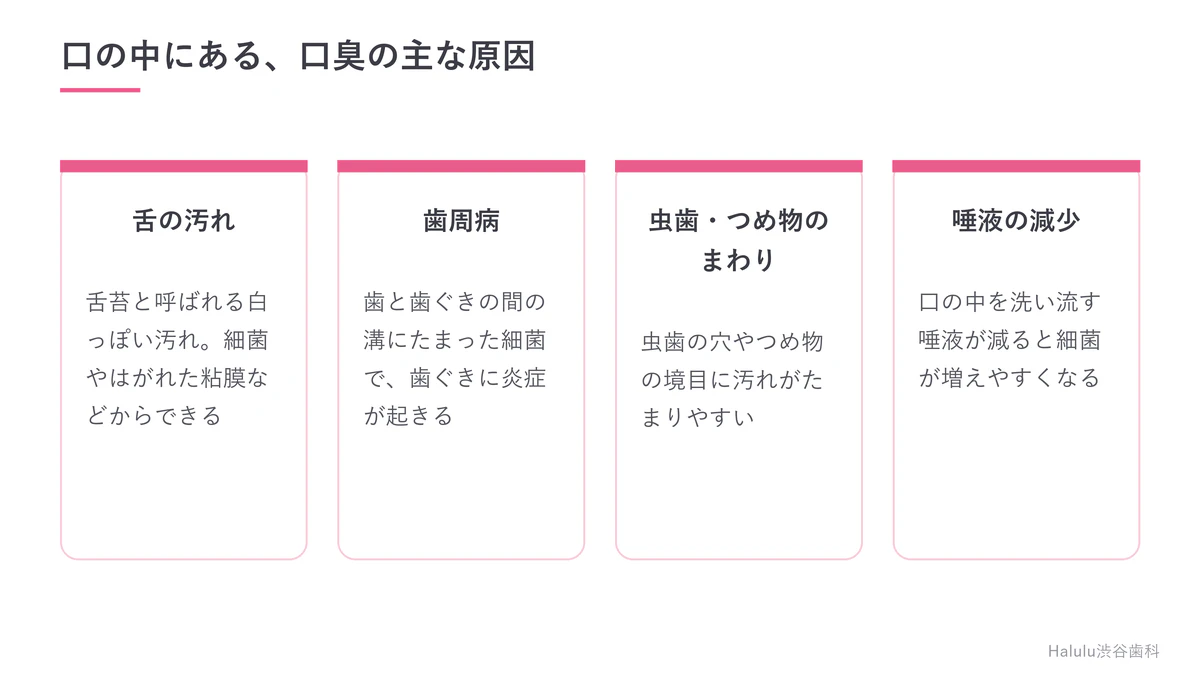
A dirty tongue (tongue coating)
Tongue coating is whitish dirt that builds up on the surface of the tongue. It is made of bacteria, shed mucous membrane, food debris, and so on, and is considered one of the major causes of bad breath. The back of the tongue is hard to reach with a toothbrush, so it can build up without you noticing.
Periodontal disease
Periodontal disease is a condition in which bacteria collected in the groove between the teeth and gums (periodontal pocket) cause inflammation of the gums. In the early stages there is almost no pain, so it is easy to miss. If a family member has pointed out your bad breath but you can't notice it yourself, we recommend suspecting periodontal disease and having an examination. This is all the more true if your gums bleed or are swollen. You can find details on our periodontal treatment page.
Dirt around cavities and fillings
Dirt collects easily in large cavity holes and at the edges of fillings and crowns. The film of bacteria (biofilm) that sticks to these places is not washed away by rinsing. A toothbrush cannot remove it completely either, and if left alone it can cause bad breath. We also explain biofilm in this column.
Reduced saliva
One of the roles of saliva is to wash out the mouth. When there is less of it, bacteria multiply more easily and the smell gets stronger. Sleeping with your mouth open makes the dryness even worse. If you are concerned about mouth breathing, please also see our self-check for tongue position and mouth breathing.
Is bad breath that only bothers me in the morning or when I'm hungry nothing to worry about?
When you wake up, when you are hungry, or when you are nervous, saliva decreases, so everyone's breath becomes stronger. This is called physiological bad breath. It weakens when saliva flows during meals or tooth brushing, so in most cases this alone does not need treatment. Smells from foods such as garlic, alcohol, and tobacco have causes separate from diseases in the mouth.
So when is it a good idea to seek advice? In cases like the following, we recommend having a dentist check once.
- Bad breath continues regardless of the time of day
- A family member or someone close to you has pointed it out
- Your gums bleed when you brush, or your gums are swollen
- You have a cavity that has gone untreated for a long time, or a filling that is coming loose
- Stickiness or dryness in your mouth continues
Can the cause be somewhere other than the mouth?
Yes. Bad breath can be caused by diseases of the nose, throat, digestive organs, liver, and so on. If we check and find no cause in the mouth, we may advise you to see an ENT (ear, nose, and throat) doctor or an internist. If you have an existing medical condition or take any medication, please tell us during the interview.
Some people are strongly worried about odor even though there is actually almost none. If the anxiety continues to the point that talking with others becomes difficult, please don't carry it alone, and talk to us about how you feel as well.
What does a dentist check for bad breath?
A dentist checks where in the mouth the cause is likely to be. At our clinic, we proceed as follows.
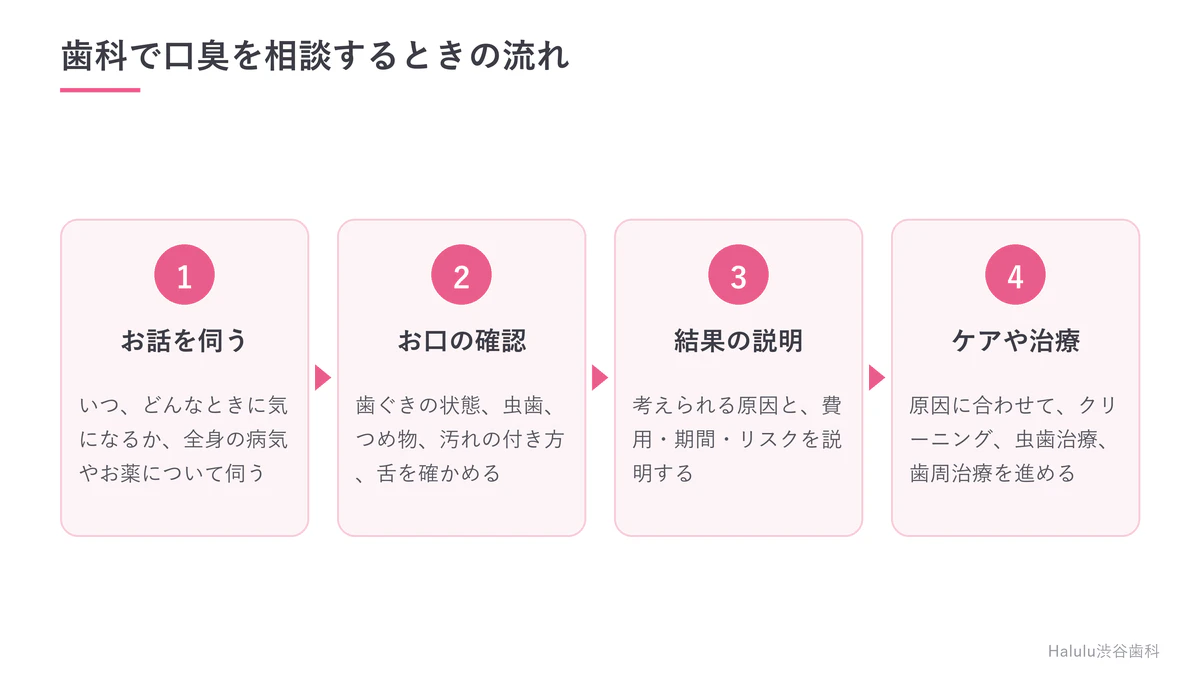
- Listening to you: We ask when and in what situations you notice it, and about any general illnesses and medications.
- Checking your mouth: We check the condition of your gums, the condition of cavities and fillings, how dirt builds up, and the condition of your tongue.
- Explaining the results: We explain the possible causes, and the cost, duration, and risks of each method.
- Cleaning or treatment: We proceed according to the cause: cleaning for dirt, cavity treatment for cavities, and periodontal treatment for periodontal disease.
For those who want a more detailed examination, there is the Oral Dock (comprehensive dental check-up). It is an examination that includes panoramic X-rays, CT, a saliva test, a detailed periodontal disease examination, and a cavity check. Because it lets you confirm the depth of your periodontal pockets, cavities in places you can't see, and the amount and properties of your saliva, it suits those who want to check all at once for hidden causes in the mouth.
What can I do myself?
In your daily care, aim to reduce dirt in your mouth and prevent dryness.
- Clean between your teeth: A toothbrush alone has trouble reaching, so use interdental brushes or dental floss every day.
- Gently remove dirt from your tongue: Use a tongue brush and move it from the back of the tongue toward the front, without pressing too hard. Scrubbing hard with a toothbrush can injure your tongue.
- Prevent dry mouth: Drinking fluids often and chewing your food well helps keep your mouth moist.
- Talk to us about tobacco: Tobacco reduces blood flow to the gums and makes periodontal disease more likely to progress. If you smoke, please talk to us.
Mouthwash and bad breath care products can help relieve the smell temporarily. However, they do not cure periodontal disease or cavities themselves. If it still bothers you even after continuing self-care, there may be dirt your toothbrush isn't reaching, or a cause that needs treatment.
Costs, and what we would like you to know
Our clinic offers self-pay (not covered by Japanese health insurance) treatment only and does not provide insurance-covered treatment. The costs are as follows (all tax included).
- First visit fee: ¥5,500 (includes counseling and a basic examination)
- Regular cleaning (30 minutes): ¥5,500
- Intensive cleaning (60 minutes): ¥11,000
- Oral Dock: ¥38,500
- Periodontal treatment: from ¥330,000 (varies depending on the degree of progression)
As a general guide, the interval between cleanings is every 3 months to every 6 months, and we suggest one to suit the condition of your mouth. Periodontal treatment is not finished in 1 visit: even mild cases take several visits, and for advanced cases we aim for improvement over several months. If treatment is needed, we explain the cost in advance after an examination. Self-pay treatment may be eligible for the medical expense deduction. Please check the latest fees on our price list.
Before you receive treatment, please also check the following points.
- How the smell changes varies from person to person, and there is not necessarily only one cause.
- If your gums are inflamed, they may bleed a little or feel sensitive during cleaning.
- After tartar is removed in periodontal treatment, your teeth may feel sensitive for a while. When gum swelling goes down, your teeth may look longer, or gaps may appear between your teeth.
- The X-rays and CT in the Oral Dock expose you to a small amount of radiation. If you are pregnant or may be pregnant, please let us know beforehand. Treatment of cavities or periodontal disease found in the examination is charged separately.
Frequently asked questions
Can I talk to a dentist about bad breath?
Yes, you can. Because most bad breath originates in the mouth, we recommend having a dentist check first. In the first-visit counseling, we also listen to concerns about bad breath.
Why do I have bad breath even though I brush my teeth?
Dirt on the tongue, bacteria inside periodontal pockets, and dirt between the teeth may not be fully removed with a toothbrush alone. Reduced saliva may also be involved.
My breath bothers me only in the morning. Do I need treatment?
Saliva decreases while you sleep, so morning breath happens to everyone. If it weakens after brushing your teeth or eating breakfast, in most cases no treatment is needed. If it lasts all day, please talk to a dentist.
Will getting a cleaning get rid of bad breath?
If the cause is dirt on the teeth, it can be expected to ease. However, if the cause is periodontal disease, cavities, or something outside the mouth, cleaning alone is not enough. After confirming the cause, we explain the method that suits you.
Should I remove the white coating on my tongue every time?
If the surface of your tongue is only slightly white, there may be nothing to worry about. Scrubbing hard can injure the tongue, so when removing it, please do so gently with a tongue brush. If the coating is thick or there is pain, please talk to a dentist.
If you want to consult about bad breath in Shibuya
Halulu Shibuya Dental Clinic is on the 4th floor of the Toyama Building in Jinnan, Shibuya-ku, a 5-minute walk from Shibuya Station on the JR and other lines. Our director, Dr. Kazuya Shiho, is a dentist who graduated from Tokyo Medical and Dental University (now Institute of Science Tokyo), and he values care centered on prevention that protects your existing teeth as much as possible. Bad breath can be hard to bring up, but if it starts to bother you, please talk to us early.
Our hours are 10:00 to 18:00 on weekdays (Monday to Friday), by appointment only. On weekends, holidays, and evenings, we see patients by appointment only on days when a doctor is in. You can book on the web (accepted 24 hours), as well as by LINE or phone (03-5422-3518). If it is your first visit, we first listen to your concerns at the first-visit counseling (first visit fee ¥5,500).
Book online at Halulu Shibuya Dental Clinic here
This article was reviewed by Dr. Kazuya Shiho, director and dentist at Halulu Shibuya Dental Clinic.