

White spots on the surface of a tooth can be an early cavity, or they can be caused by the period when the tooth was forming and not be a cavity at all. The best clues for telling them apart are "since when it has been there" and "where it is." If the white spot appeared later and is at the border between the tooth and the gum, or where an orthodontic appliance used to be attached, it may be an early cavity. If it has been there since the tooth came in, and its shape and size haven't changed, it is often an effect of the period when the tooth was forming.
You may have looked in the mirror and worried, "Is this a cavity?" However, it is hard to decide which it is from appearance alone. In this article, Halulu Shibuya Dental Clinic in Jinnan, Shibuya explains the main causes of white spots and how to tell them apart, a guide to whether it's okay to leave them, what you can do at home, and the signs that mean you should see a dentist. For more on how white spots are treated, please see our white spot page.
Why do white spots form on teeth?
White spots and cloudy areas on the tooth surface are called "white spots" or "white spot lesions" (はくはん) in dentistry. The causes fall broadly into the following 3.
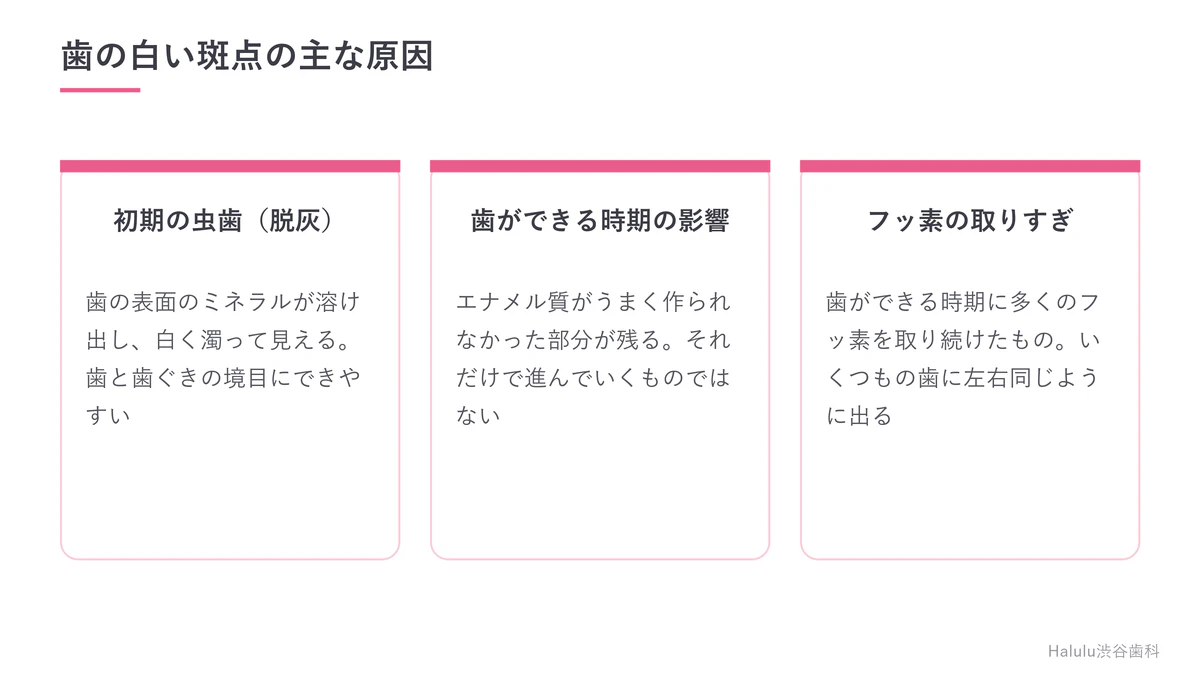
1. Early cavity (demineralization)
A cavity starts, before a hole forms, when minerals in the tooth surface begin to dissolve out. The areas that have lost minerals let light pass through differently, so they look cloudy and white. This stage is called "demineralization" (脱灰, dakkai). It tends to form at the border between the tooth and the gum, where brushing is hard to reach.
2. Effects from the period when the tooth was forming (hypoplasia)
Teeth are made inside the jawbone before they come in. During that time, areas where the surface enamel was not formed well can remain as white spots. Injuries or cavities in the baby teeth can also show up later in the permanent teeth that come in afterward. Since this is not a cavity, it does not progress on its own.
3. Taking in too much fluoride
If a lot of fluoride is taken in continuously while the teeth are forming, fine white streaks or spots can appear. A typical feature is that they appear on several teeth, in the same way on the left and right.
How can you tell whether it's a cavity?
The following table is a guide for telling them apart. The side with more matching items is considered more likely, but in the end a dentist needs to check.
What to look at | Possibly an early cavity | Possibly an effect from when the tooth was forming |
|---|---|---|
Since when | It wasn't there before. You noticed it recently | It has been there since the tooth came in |
Where it is | The border between the tooth and the gum, or where an orthodontic appliance was attached | Toward the tip or the middle of the tooth. It may appear on the same teeth on the left and right |
Appearance | Dull, white like chalk | Glossy, looks mottled or like streaks |
Changes | Spreads or increases in number | Shape and size do not change |
White spots look clearer when the teeth are dry. This is why they stand out right after you wake up or after you've kept your mouth open, and that alone does not mean they have gotten worse.
Is it okay to leave a white spot alone?
This is what people most want to know, but the answer depends on the cause.
- If it is an early cavity: At this stage, reviewing how you brush and use fluoride may allow minerals to return and stop the progression. If it is left alone and demineralization advances, the surface breaks down and a hole forms, and treatment to drill and fill the tooth becomes necessary.
- If it is an effect from when the tooth was forming: Because it rarely progresses by itself, choosing not to treat it is also an option if the appearance doesn't bother you. However, if the surface enamel is weak, the tooth may be prone to cavities, so having it checked regularly gives peace of mind.
Either way, if you find a white spot, we recommend having a dentist check the cause at least once. Once the cause is known, it can be decided whether it is fine to keep an eye on it or better to act early.
What can you do at home?
If the cause is an early cavity, daily habits can help stop its progression. If the cause is an effect from when the tooth was forming, they are also useful for preventing new cavities.
- Use fluoride toothpaste: After brushing, rinse just once with a small amount of water, and the fluoride will be more likely to stay on your teeth.
- Brush the border between the tooth and the gum carefully: This is a place where white spots tend to form. Place the toothbrush on the border and move it in small motions.
- Don't snack on sweet foods or drinks little by little all day: The longer your mouth stays acidic, the more easily minerals dissolve out. We recommend having them at set times.
Commercially available toothpaste and whitening products cannot make white spots disappear. Also, when you whiten your teeth, the spots may look temporarily more noticeable in the process of the whole tooth becoming whiter. If you are thinking about whitening, please talk to us about the condition of the spots first.
If this applies to you, see a dentist early
In the following cases, a cavity may be progressing.
- The white spot has spread or increased compared with before
- The white spot has turned brown or blackish
- The surface feels rough, or it looks like there is a small hole
- Cold or sweet things cause sensitivity
- White spots appeared around the appliance after your orthodontic appliance was removed
For white spots on a child's teeth too, we can check whether it is an early cavity or an effect from when the teeth were forming. For children's prevention, please also see Preventive Dentistry for Children and Maternity.
What a dentist can do when white spots bother you
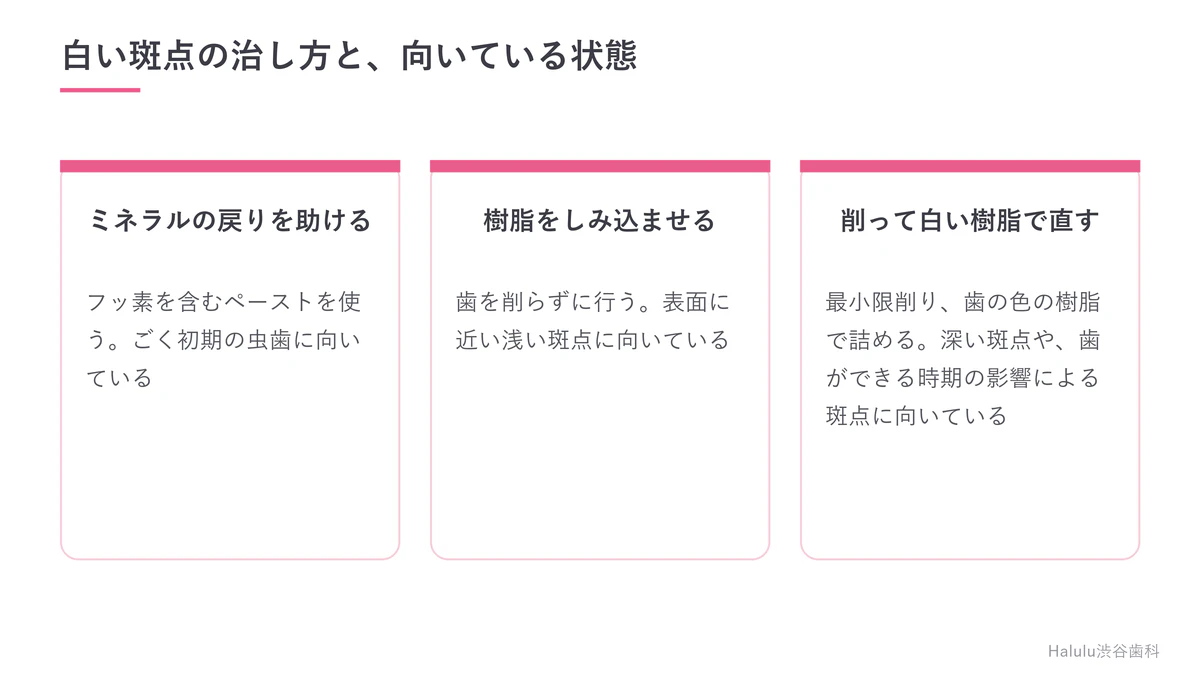
At Halulu Shibuya Dental Clinic, after checking the cause and depth of the spot, we propose a method chosen from the following. Our policy is to start from reducing the amount of tooth removed as much as possible.
- Helping minerals return: We use a fluoride-containing paste to help minerals return to the tooth surface. This is suited to very early cavities.
- Infiltrating resin: Resin is infiltrated into the cloudy white area to blend it with the color of the surrounding tooth. This is done without drilling the tooth, and it is suited to shallow spots close to the surface.
- Drilling and repairing with white resin: The area is drilled to a minimum and filled with resin matched to the color of the tooth. This is suited to deep spots and spots caused by effects from when the tooth was forming.
When whitening a tooth that has a spot, adjusting the color of the teeth first and then making the spot less noticeable makes the result blend in more easily. For this reason, mild white spot treatment is provided on the condition that it is done at the same time as whitening.
White spot treatment is self-pay (not covered by Japanese health insurance). Our clinic offers self-pay treatment only and does not provide insurance-covered treatment. The fee per tooth is ¥3,500 for mild cases (it must be done at the same time as whitening) and ¥33,000 for severe cases (¥16,500 from the 2nd tooth), all tax included. The number of visits varies depending on the method and the number of teeth, and the resin infiltration method is in many cases done in 1 visit.
Before you receive treatment, please also check the following points.
- Depending on the depth and cause of the spot, it may not become completely unnoticeable.
- Areas repaired with resin may change color or wear down over time.
- If the cause is an early cavity, new white spots may form unless you review how you brush your teeth.
You can find details for each method on the white spot page, and fees on the price list.
Frequently asked questions
Do white spots on teeth go away on their own?
If the cause is an early cavity and it is still at a shallow stage, brushing with fluoride and similar care may allow minerals to return and make the spot less noticeable. Spots caused by effects from when the tooth was forming do not go away on their own.
Can white spots form in adulthood too?
Yes, they can. White spots that form in adulthood are often early cavities, and they are commonly seen at the border between the tooth and the gum and around orthodontic appliances. We recommend having the cause checked early.
Will whitening make white spots less noticeable?
Whitening alone does not make the spots disappear, and the spots may look temporarily more noticeable in the process of the whole tooth becoming whiter. Before whitening, we check the condition of the spots and, if necessary, combine it with treatment of the spots.
If I find a white spot, do I need treatment right away?
Treatment is not necessarily needed right away. If the cause is an effect from when the tooth was forming and the appearance doesn't bother you, we may also keep an eye on it. In the case of an early cavity, it is important to act before it progresses, so please see us once to check the cause.
If you want to consult about white spots on your teeth in Shibuya
Halulu Shibuya Dental Clinic is on the 4th floor of the Toyama Building in Jinnan, Shibuya-ku, a 5-minute walk from Shibuya Station (JR and other lines). Our director is Kazuya Shiho, a dentist who graduated from Tokyo Medical and Dental University (now Institute of Science Tokyo). We value care that centers on prevention and protects your existing teeth as much as possible, so you are welcome to consult us starting from checking whether a white spot is a cavity.
Our hours are 10:00 to 18:00 on weekdays (Monday to Friday), by appointment only. On weekends, public holidays and evenings, we see patients by appointment only on days when a doctor is in. Please check the calendar when booking for details. You can book on the web (accepted 24 hours), and also by LINE or phone (03-5422-3518). If it is your first visit, please start with an initial consultation (initial consultation fee ¥5,500), a time for us to hear your concerns.
Book online at Halulu Shibuya Dental Clinic here
This article was supervised by Dr. Kazuya Shiho, director and dentist at Halulu Shibuya Dental Clinic.