
Partial orthodontics for the front teeth only is possible, depending on your tooth alignment. As a guide, it may be an option when what bothers you is mild crowding, a gap, or twisting of the front teeth, and there is no problem with how the back teeth bite together. On the other hand, if the whole bite is out of alignment, as with protruding front teeth (overjet) or an underbite, or if there is a large shortage of space to line up the teeth, full orthodontics may be necessary.
Some of you may feel, "Only my front teeth bother me, so isn't moving all of my teeth overkill?" In this article, Halulu Shibuya Dental Clinic in Jinnan, Shibuya explains the differences between partial and full orthodontics, which tooth alignments suit partial orthodontics and which are difficult, and how to think about duration and cost. Information on orthodontic methods and a guide to costs is also available on our orthodontic consultation page.
How does partial orthodontics for the front teeth differ from full orthodontics?
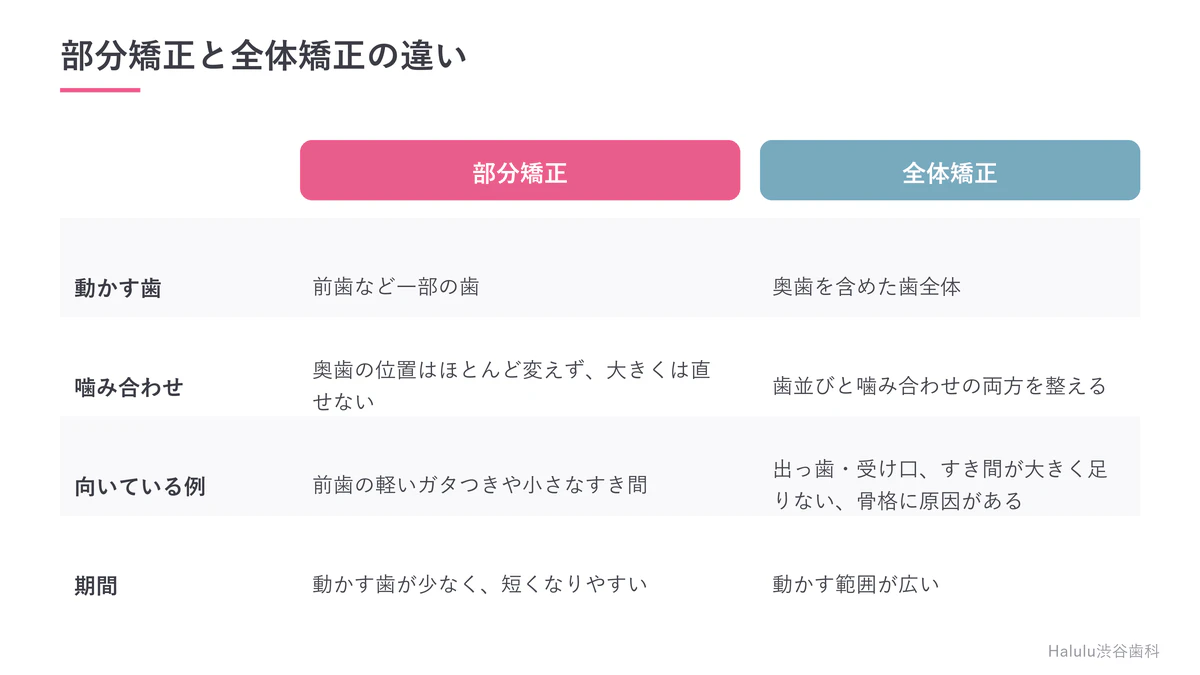
Partial orthodontics is a method that moves only some teeth, such as the front teeth, to improve appearance. Full orthodontics moves all of the teeth, including the back teeth, and corrects both the tooth alignment and the bite.
The biggest difference is whether the bite is changed as well. Because partial orthodontics hardly changes the position of the back teeth, it cannot greatly correct the bite. In exchange, fewer teeth are moved, so the treatment period tends to be shorter.
Appliances used in partial orthodontics
For partial orthodontics, clear aligners (mouthpieces) or wires attached only around the teeth you want to move are generally used. Aligners are transparent and hard to notice, and can be removed for meals and tooth brushing, but they require the self-discipline of wearing them for most of the day. Wires cannot be removed by yourself, so there is no worry about forgetting to wear them, but the appliance is visible when it is attached to the front surface of the teeth. Which appliance we use at our clinic is proposed after examinations confirm in which direction and how far the teeth need to move. For the features of each appliance, please see our pages on aligner orthodontics, wire orthodontics (front side), and wire orthodontics (back side).
Which tooth alignments suit partial orthodontics for the front teeth?
Partial orthodontics is likely to be an option in cases like the following.
- The front teeth overlap slightly or are mildly crowded
- There is a small gap between the front teeth
- One front tooth is twisted or slightly out of position toward the front or back
- You had orthodontic treatment before, and the alignment of the front teeth has shifted back a little
In every case, the premise is that there is no problem with how the back teeth bite together and that the amount of movement is small. Even when things look similar, the cause may lie in the position of the back teeth or the jaw structure. This cannot be told just by looking in a mirror, so we confirm it through examinations.
When the front teeth have shifted back after previous orthodontic treatment
If you stop using a retainer after orthodontic treatment, the tooth alignment may return to its original state. If only the front teeth have shifted back over a small range, partial orthodontics may be able to realign them. After realigning, a retainer is used so that the teeth do not shift back again.
In which cases is partial orthodontics difficult?
In cases like the following, moving only the front teeth makes it hard to improve the appearance and the bite, and we may propose full orthodontics.
- The positional relationship between the upper and lower front teeth is greatly off, as with protruding front teeth (overjet) or an underbite
- The upper and lower front teeth do not close when you bite with the back teeth
- There is a large shortage of space for the teeth to line up, and teeth would need to be extracted
- The centers of the upper and lower teeth are greatly misaligned
- The cause lies in the jaw structure
If you try to correct such alignments with the front teeth alone, the front teeth may tilt forward so that the mouth area looks protruded, or the bite may get worse. Even when the front teeth are what bother you, it is important to decide the scope of treatment after examining the alignment of all the teeth.
We also check the condition of your gums
If the bone supporting your teeth has weakened because of periodontal disease, moving teeth may make the condition worse, for example by causing the gums to recede. If there is inflammation in the gums, our approach at our clinic is to first carry out periodontal treatment and then consider orthodontics.
Besides orthodontics, are there other ways to improve the front teeth?
Depending on how the gaps or shape of your front teeth bother you, there are also methods that improve their appearance without moving the teeth.
For small gaps or chips, direct bonding (¥22,000, tax included), which shapes the tooth by building up dental plastic close to the color of your tooth, may be able to fix them. Because no impression is taken, it is basically a treatment that is completed on the same day. There is also a method of adjusting the shape and orientation by placing a ceramic crown (the cost varies depending on the location and type; please check the price list for details), but the amount of tooth that is shaved down increases.
Neither changes the position of the teeth themselves, so they are not suitable when the crowding is large. Move the teeth, or adjust their shape? We will explain so that you can compare the advantages and burdens of each and make your choice.
How long does partial orthodontics take?
The duration of partial orthodontics depends on the number of teeth moved and the distance. Generally, it is said that in many cases the teeth finish moving in several months to about 1 year. After that comes the period of keeping the alignment with a retainer.
The smaller the range moved, the shorter the period tends to be. However, if you do not wear the aligners for enough hours, the teeth may not move as planned and the period may be extended. The guideline for the duration of full orthodontics and what affects the duration are summarized in our column on the duration of aligner orthodontics for adults.
Retention after the teeth have finished moving is also part of the treatment
After teeth are moved, they try to return to their original positions. This is the same with partial orthodontics, and if you do not use a retainer, the alignment may shift back. If you have a habit of pushing the front teeth with your tongue or keeping your mouth open all the time, the teeth may shift back more easily, and in that case we may also propose exercises to correct the habit (MFT (myofunctional therapy)).
The flow from consulting about partial orthodontics for the front teeth to starting treatment
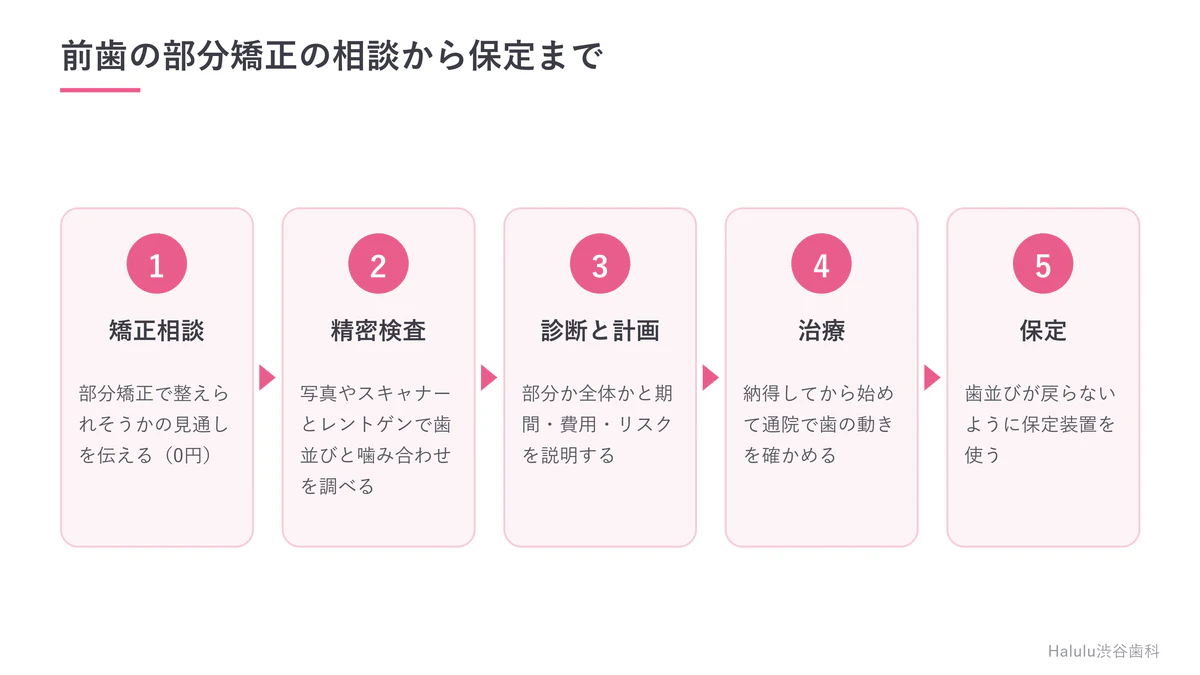
At our clinic, we proceed as follows.
- Orthodontic consultation (¥0): We ask about the areas that concern you and your wishes, look inside your mouth, and tell you our outlook on whether partial orthodontics seems able to straighten your teeth.
- Detailed examination (orthodontic diagnosis ¥33,000): We examine your tooth alignment and bite through photographs, impressions taken with an intraoral scanner, X-rays, and so on.
- Explanation of the diagnosis and treatment plan: We explain how the teeth would be moved, the duration, cost, and risks, including whether partial orthodontics is enough or full orthodontics is needed.
- Treatment: Treatment begins only after you are satisfied. You visit the clinic so that we can check how your teeth are moving.
- Retention: A retainer is used so that the realigned teeth do not shift back.
Orthodontic treatment is handled by Dr. Takagi (高木 豪馬), a certified orthodontist of the Japanese Orthodontic Society. You do not have to start treatment just because you had a consultation. Even if you are at the stage of "I just want to know whether partial orthodontics can do it," please feel free to consult us.
Costs and risks we would like you to know about
Orthodontic treatment is self-pay (not covered by Japanese health insurance). Our clinic offers self-pay treatment only and does not provide insurance-covered treatment. The costs are as follows (all tax included).
- Orthodontic consultation: ¥0
- Orthodontic diagnosis (detailed examination): ¥33,000
- Adjustment fee: ¥5,500
The cost of partial orthodontics varies depending on the range of teeth moved and the appliance used, so we tell you after the diagnosis, together with the treatment plan. For reference, adult full orthodontics that moves all the teeth costs ¥850,000 with front-side wires, ¥1,350,000 with back-side wires, and ¥960,000 with aligner orthodontics. Self-pay treatment may be eligible for the medical expense deduction. Please check the latest prices on the price list.
The appliances used in our aligner orthodontics are either medical devices not approved in Japan under the Pharmaceuticals and Medical Devices Act, or devices whose finished product is outside the scope of that Act. Information on how they are obtained, whether there is an approved device in Japan with the same purpose, safety in other countries, and so on is provided on our aligner orthodontics page.
Please also confirm the following points before undergoing treatment.
- When you first start wearing the appliance and after adjustments, you may feel pain or discomfort, such as a feeling that your teeth are loose.
- Dirt tends to remain around the appliance, and if tooth brushing is insufficient, cavities and gum inflammation are more likely to occur.
- To create space for lining up the teeth, the sides of the teeth may be shaved slightly.
- The roots of the teeth may become shorter, or the gums may recede.
- Because partial orthodontics cannot greatly change the bite, there is a limit to the range that can be corrected.
- The treatment period may become longer than planned depending on how the teeth move and your attendance at appointments.
- If you do not use a retainer, the tooth alignment may return to its original state.
Frequently asked questions
Can you straighten just one front tooth?
Depending on the tooth alignment, yes. However, to move one tooth, space is needed between it and the surrounding teeth, so the neighboring teeth are often moved a little as well. Which teeth to move and how far will be proposed after the examinations.
Is partial orthodontics cheaper than full orthodontics?
Because fewer teeth are moved, it is generally said to be easier to keep the cost lower than with full orthodontics. At our clinic, the cost varies depending on the range moved and the appliance, so we tell you after the diagnosis, together with the treatment plan.
What happens if I want full orthodontics after partial orthodontics?
You can start full orthodontics after partial orthodontics. However, teeth that have already been moved once would be moved again. If you would like to have your bite corrected as well, please tell us at the first consultation. We will explain and compare both methods.
Can I have partial orthodontics as an adult?
If your teeth and gums are healthy, you can have orthodontic treatment as an adult. If you have periodontal disease, we may treat the gums first. For children, children's orthodontics, which makes use of jaw growth, is also one option.
Is it okay to come for a consultation only?
Yes, a consultation only is fine. The orthodontic consultation is ¥0, and we tell you our outlook on whether partial orthodontics seems possible or full orthodontics is needed. Please hear that first, and then think about whether to have orthodontic treatment.
If you are considering a consultation about partial orthodontics for the front teeth in Shibuya
Halulu Shibuya Dental Clinic is located on the 4th floor of the Toyama Building in Jinnan, Shibuya-ku, a 5-minute walk from Shibuya Station (JR and other lines). Director Kazuya Shiho is a dentist who graduated from Tokyo Medical and Dental University (now Institute of Science Tokyo), and values care that centers on prevention and protects your existing teeth as much as possible. Orthodontic treatment is handled by Dr. Takagi (高木 豪馬), a certified orthodontist of the Japanese Orthodontic Society.
Our hours are 10:00 to 18:00 on weekdays (Monday to Friday), by appointment only. On weekends, national holidays, and evenings, we see patients by appointment only on days when a doctor is in. Please check the calendar at the time of booking for details. Appointments can be made on the web (accepted 24 hours), and also by LINE or phone (03-5422-3518). For consultations about your tooth alignment, please use our orthodontic consultation (¥0).
Book online at Halulu Shibuya Dental Clinic here
This article was reviewed by Dr. Kazuya Shiho, Director and dentist at Halulu Shibuya Dental Clinic.